How to Find Multibagger Stocks in PSX: 7-Step Guide
A multibagger is a share that multiplies your money several times. On the PSX, the biggest gains of 2023 to 2026 came from large, cheaply valued companies, many of them banks, that re-rated as interest rates fell from 22%, not from penny stocks. Look for growing earnings, low P/E and P/B, little debt and a catalyst.
Key takeaways
- The KSE-100 rose from 40,504 points on 9 January 2023 to 185,557 on 8 January 2026, about 4.6 times, as the policy rate fell from 22% to 10.5%.
- UBL grew from under $500 million in market value to $4.5 billion in three years, and the number of PSX companies worth over $1 billion rose from 3 to 19.
- In July to December 2025, the best KSE-100 performer was the Bank of Punjab, with a total shareholder return of 292.53%. Four of the top nine companies were banks.
- Those winners were large, liquid and cheap on earnings and book value before they rose. Most were not penny stocks.
- A 10-times return in ten years needs about 26% a year. Spread your money across several picks, because most will not become multibaggers.
PSX retail investor
M Zubair is a retail investor on the Pakistan Stock Exchange. He writes SeekhKar's guides to explain the basics of investing, such as reading annual reports, P/E ratios, dividends and valuation, in simple language for new PSX investors. Everything here is for learning, not investment advice.
What Is a Multibagger Stock?
A multibagger is a share whose price, plus dividends, grows to several times what you paid. A stock that doubles is a two-bagger, one that grows fivefold is a five-bagger, and so on. The term comes from Peter Lynch, who called a stock that rose ten times a "ten-bagger".
The arithmetic shows why multibaggers are rare. To grow ten times in ten years, a share has to return about 26% a year, every year. At 15% a year, it grows about four times in ten years. To grow five times in five years, it needs about 38% a year. These returns usually come only when a company's profits grow fast and investors start paying more for each rupee of those profits.
| Grows to | In | Needs a year |
|---|---|---|
| 2x | 5 years | 14.9% |
| 5x | 5 years | 38.0% |
| 4x | 10 years | 14.9% |
| 10x | 10 years | 25.9% |
What the PSX's Recent Multibaggers Had in Common
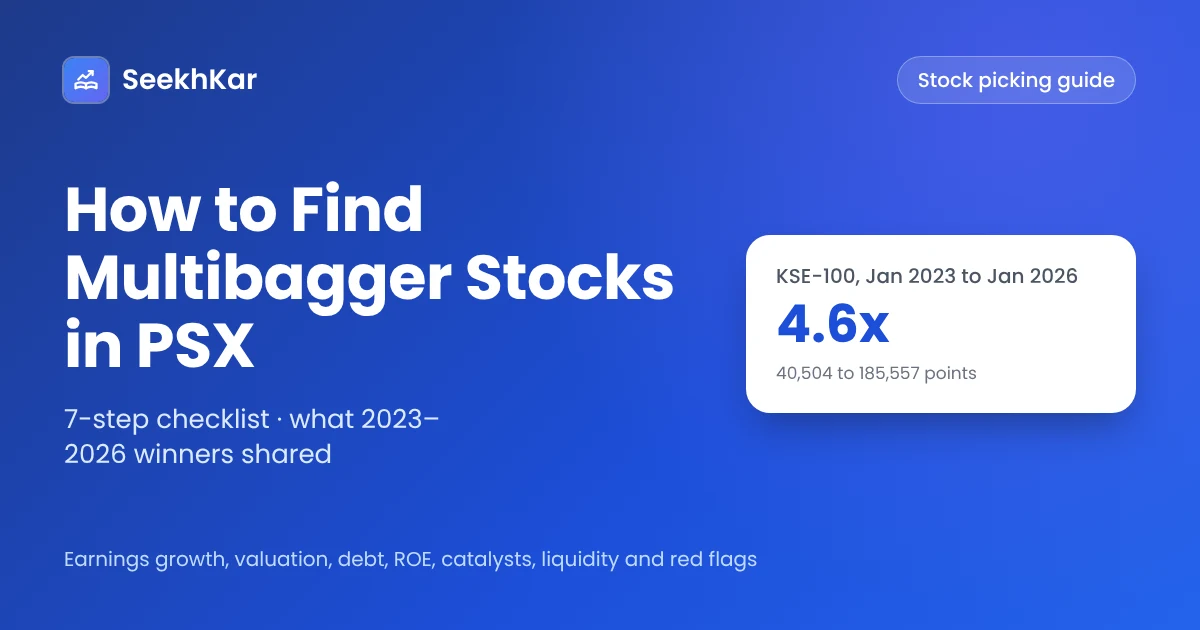
Pakistan has just had one of the biggest stock market rallies in the world, so it is the best place to look for patterns. The KSE-100 index rose from 40,504 points on 9 January 2023 to 185,557 points on 8 January 2026, about 4.6 times in three years. Over roughly the same period, the policy rate fell from 22% to 10.5%. UBL, the largest listed company, grew from less than $500 million in market value to $4.5 billion, and the number of PSX companies worth more than $1 billion rose from 3 to 19.
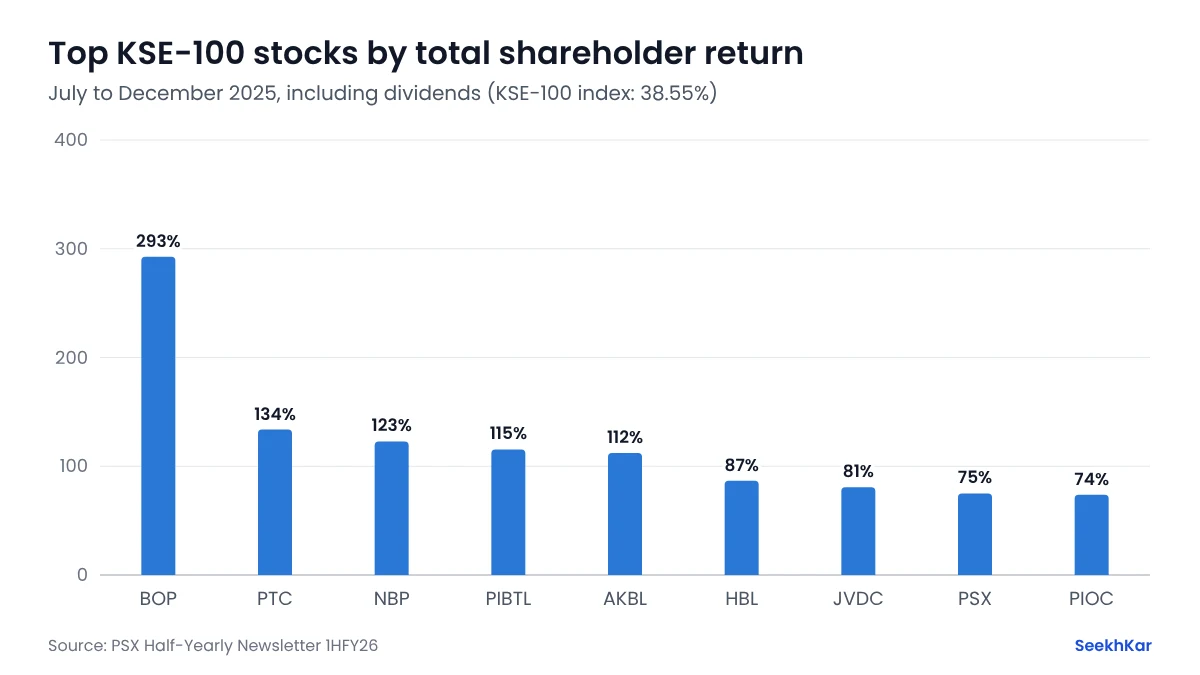
The PSX's own newsletter lists the KSE-100 stocks with the highest total shareholder return, which includes dividends, in the six months from July to December 2025. The index itself returned 38.55% in that half year.
| Company (ticker) | Return, Jul–Dec 2025 |
|---|---|
| Bank of Punjab (BOP) Bank | 292.53% |
| PTCL (PTC) Telecom | 133.77% |
| National Bank of Pakistan (NBP) Bank | 122.82% |
| Pakistan International Bulk Terminal (PIBTL) Port terminal | 115.45% |
| Askari Bank (AKBL) Bank | 112.23% |
| Habib Bank (HBL) Bank | 86.75% |
| Javedan Corporation (JVDC) Real estate | 80.79% |
| Pakistan Stock Exchange (PSX) Stock exchange | 75.04% |
| Pioneer Cement (PIOC) Cement | 73.69% |
Three patterns stand out, and they are the opposite of most "multibagger tips":
- They were big and liquid. All of them were in the KSE-100, the index of the largest and most traded companies. Most were not penny stocks.
- They started from low valuations. When interest rates fell and the economy steadied, investors became willing to pay more for each rupee of profit, so share prices rose faster than earnings. This re-rating is what turns steady profit growth into a multibagger.
- They had a catalyst. Falling interest rates, an IMF programme and rating upgrades helped the whole market. Some companies also had their own trigger, such as PTCL's deal to buy Telenor Pakistan.
Bank of Punjab's return in that half year means a share almost quadrupled (3.9 times) in six months. Even after that, our comparison of BOP, HabibMetro, Askari, Allied and Standard Chartered found BOP at 5.1 times earnings and 0.89 times book value in November 2026, with 9M 2026 EPS up 24.1%. That shows how cheap it was before the rally. It is not a forecast that the rise will continue.
How to Find Multibagger Stocks in PSX: A 7-Step Checklist
No checklist can tell you which stock will multiply. What it can do is rule out the stocks that almost never do, and narrow the rest to a short list worth reading about in depth. Work through these seven checks in order:
- Start with a business that can grow for years. Ask what could make this company's profit two or three times bigger in five years: more demand, new capacity, exports, a lower cost base or lower interest rates. If you cannot answer, move on.
- Check that profit is already growing. Look at the last few quarterly results on the PSX Data Portal. You want earnings per share (EPS) and revenue rising, not one good quarter from a one-off gain.
- Buy it cheap. Compare the price-to-earnings (P/E) and price-to-book (P/B) ratios with other companies in the same sector. Multibaggers usually start at a low multiple; a stock already priced at 30 times earnings needs everything to go right. Our guide to finding undervalued stocks in Pakistan explains the ratios.
- Look for little or no debt. Companies with heavy borrowing can be wiped out by a rise in interest rates. For power and oil and gas companies, also check receivables: money stuck in circular debt does not reach shareholders.
- Check return on equity (ROE). A company that earns 20% or more on its shareholders' money can grow without raising new capital. A useful test in Pakistan is whether ROE beats what you could get risk-free: the policy rate is 12% from 27 October 2026.
- Find the catalyst. Something has to make other investors notice: falling interest rates, a new plant coming on line, a change in management, a large order, or a jump in dividends.
- Check that you can buy and sell it. Look at daily traded volume and how many shares are freely traded. A thinly traded stock can rise fast on a few buyers and fall just as fast when they sell.
Then put a number on it. Estimate what the company might earn in three to five years and what P/E is reasonable for it, and see what share price that implies. Our intrinsic value calculator does this with the Graham, DCF, P/E and dividend methods.
| Check | Where to find it | What to look for |
|---|---|---|
| Earnings growth | Quarterly results on the PSX Data Portal | EPS rising over several quarters |
| Valuation | Share price ÷ EPS and ÷ book value per share | Lower than sector peers |
| Debt | Balance sheet in the latest accounts | Net debt small next to equity |
| Returns | Profit ÷ shareholders' equity | ROE above the policy rate |
| Catalyst | Company announcements and results notes | A clear reason profits or the multiple can rise |
| Liquidity | Daily volume on the PSX Data Portal | Regular trading, not a few big days |
Red Flags: Why Most Multibagger Tips Fail
The PSX has more than 500 listed companies in more than 35 sectors. Most of them will never multiply, and some of the most-tipped stocks are the riskiest. Watch for these warning signs:
- A low share price is not the same as cheap. A Rs 5 share can be expensive if the company makes no profit. Judge value by P/E, P/B and cash flow, not by the price per share.
- Tips on WhatsApp, Telegram or social media. A sudden rush of messages about one small stock, with big volume and no news from the company, is a common pattern before a sharp fall.
- Losses and no dividends for years. A turnaround can work, but most loss-making companies stay that way. Wait for profit to show up in the results.
- Few shares in free float. When the sponsors hold most of the shares, a small amount of buying can move the price a lot, in both directions.
- Debt and related-party dealings. Large loans, money owed by associated companies, or auditors' qualifications in the annual report are reasons to walk away.
How to Invest for Multibagger Returns Without Betting Everything
Even careful investors are wrong often. Most multibagger hunters make their money because a few winners more than pay for the losers. That only works if no single pick can sink you.
Say you split Rs 100,000 equally across ten stocks that pass the checklist. If one grows five times, two double, four stay flat and three halve, your Rs 100,000 becomes Rs 145,000: Rs 50,000 + Rs 40,000 + Rs 40,000 + Rs 15,000. One winner did most of the work. Had you put everything in one of the losers, you would have Rs 50,000.
- Hold for years, not weeks. Profits take time to grow. The rally above started from the low prices of early 2023, when the KSE-100 was near 40,000 points.
- Keep adding regularly. Investing a fixed amount each month means you buy more shares when prices are low.
- Know when to sell. Sell if the reason you bought has gone, such as profit falling or debt rising, not just because the price has gone up.
- Judge new listings the same way. An IPO can be bought at the offer price before trading starts, but apply the same checklist to it. Our guide on how to apply for an IPO in Pakistan explains the process.
To see where each sector stands today, start from our KSE-100 comparisons, which put the main stocks in each industry side by side on P/E, P/B, dividends, ROE and debt.
This guide is educational and is not a recommendation to buy or sell any stock. Past returns, including those in this article, do not tell you what any stock will do next.
Sources & Further Reading
- PSX Half-Yearly Newsletter 1HFY26 (top KSE-100 stocks by total shareholder return)
- Nukta: Pakistan stock market emerges as major wealth creator (8 Jan 2026)
- ARY News: State Bank of Pakistan raises policy rate to 12% (26 Oct 2026)
- PSX: investment guide and financial planning (listed companies and sectors)
- PSX Data Portal: company results, prices and volumes