Shifa vs Service Industries vs PIBTL vs JVDC Stocks 2026
On 5 November 2026 prices, PIBTL scores best on our scorecard: the lowest P/E and P/B, and Q1 FY27 profit up 31%, but no dividend. Javedan pays the highest yield, 4.4%, but its latest quarter relied on a one-off REIT gain. Service Industries earns the highest ROE, 30%. Shifa holds more cash than debt, but its EPS fell 18%.
Key takeaways
- PIBTL scores 11 on our six-measure scorecard (lower is better), Shifa 15, Service Industries 16 and Javedan 18.
- PIBTL's July to September profit rose 31% to Rs 810 million as the cargo it handled rose 27%, but it declared no dividend.
- Shifa's consolidated EPS fell 18% to Rs 9.56 in Q1 FY27, while the parent company's own EPS rose 8% to Rs 12.71.
- Javedan booked about Rs 1.03 billion of gains on its Naya Nazimabad Apartment REIT units, more than its whole pre-tax profit for the quarter.
- Service Industries split each share into ten in August 2026, so its share price and per-share figures are now a tenth of their old size.
PSX retail investor
M Zubair is a retail investor on the Pakistan Stock Exchange. He writes SeekhKar's guides to explain the basics of investing, such as reading annual reports, P/E ratios, dividends and valuation, in simple language for new PSX investors. Everything here is for learning, not investment advice.
Shifa vs Service Industries vs PIBTL vs Javedan: Valuation at a Glance
Shifa International Hospitals (SHFA), Service Industries (SRVI), Pakistan International Bulk Terminal (PIBTL) and Javedan Corporation (JVDC) sit in the KSE-100's "miscellaneous" group, outside the large sectors we have compared. Shifa runs hospitals in Islamabad and Faisalabad. Service Industries makes Servis shoes, tyres and other rubber products. PIBTL runs a terminal for coal, clinker and cement at Port Qasim, Karachi. Javedan develops Naya Nazimabad, a housing scheme in Karachi. Prices are PSX closing prices on 5 November 2026.
Earnings are trailing twelve months (TTM) to 30 September 2026. Shifa, PIBTL and Javedan end their year in June, so their TTM EPS is FY26 EPS minus July to September 2025 plus July to September 2026. Service Industries ends its year in December, so its TTM EPS is 9M 2026 plus October to December 2025. Dividends are those paid or declared in the last twelve months.
| Metric | SHFA | SRVI | PIBTL | JVDC |
|---|---|---|---|---|
| Share price, 5 Nov 2026 | Rs 437.31 | Rs 167.28 | Rs 13.42 | Rs 135.68 |
| Market capitalisation | Rs 28 bn | Rs 79 bn | Rs 24 bn | Rs 52 bn |
| EPS, TTM | Rs 37.68 | Rs 19.70 | Rs 1.99 | Rs 10.18 |
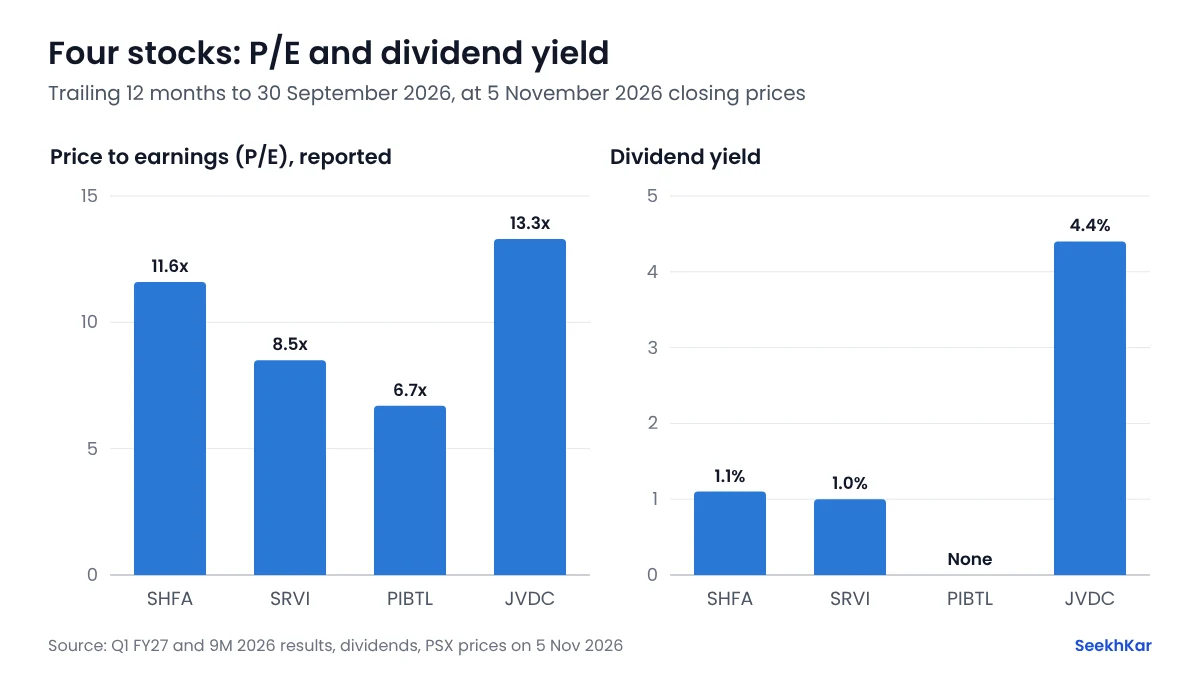
| P/E, TTM | 11.6x | 8.5x | 6.7x | 13.3x |
| P/E without Javedan's REIT gain | n/a | n/a | n/a | 16.8x |
| Book value per share, 30 Jun 2026 | Rs 276.72 | Rs 64.98 | Rs 10.55 | Rs 79.34 |
| P/B | 1.58x | 2.57x | 1.27x | 1.71x |
| ROE (TTM EPS ÷ book value) | 13.6% | 30.3% | 18.9% | 12.8% |
| Dividends, last 12 months | Rs 5 | Rs 1.75 | None | Rs 6 |
| Dividend yield | 1.1% | 1.0% | 0% | 4.4% |
| EPS growth, latest results | −18% | +7% | +29% | −5% |
| Net debt ÷ equity, 30 Jun 2026 | −0.05x | 0.75x | 0.12x | 0.15x |
Latest results are July to September 2026 for Shifa, PIBTL and Javedan, and the nine months to September 2026 for Service Industries. Figures are consolidated where the company reports group accounts, and Service Industries' per-share figures are restated for its share split. Debt is compared with total equity, including minority shareholders. Book values, debt and cash are from S&P Global data; a negative net debt figure means more cash than debt. The P/E without Javedan's REIT gain assumes the Rs 1.04 billion of gains in its accounts were taxed at the quarter's 24% effective rate, which takes Rs 2.09 off its EPS.
Which Stock Is Cheapest?
PIBTL, on both price measures. It trades at 6.7 times trailing earnings and 1.27 times book value, and its July to September profit rose 31%. The catch is that it pays no dividend and its earnings swing with coal imports: it lost Rs 258 million in FY25 before earning Rs 3.37 billion in FY26.
Service Industries is next on earnings, at 8.5 times, but it is the most expensive on book value, at 2.6 times, because it earns a 30% return on its book. Shifa trades at 11.6 times earnings. Javedan looks like 13.3 times, but without its one-off REIT gain it is about 16.8 times, the most expensive of the four. Our guide to P/E ratios by sector explains why one-off gains make a P/E look cheaper than it is.
Latest Results: Q1 FY27 and 9M 2026
| Company | Period | Revenue (change) | Profit after tax (change) |
|---|---|---|---|
| Shifa | Q1 FY27 | Rs 9.30 bn (+22%) | Rs 509 m (−31%) |
| Service Industries | 9M 2026 | Rs 130.86 bn (+20%) | Rs 13.40 bn (+12%) |
| PIBTL | Q1 FY27 | Rs 5.12 bn (+29%) | Rs 810 m (+31%) |
| Javedan | Q1 FY27 | Rs 465 m (−74%) | Rs 676 m (−5%) |
- Shifa: revenue rose 22%, but consolidated profit after tax fell to Rs 509 million from Rs 742 million, and EPS to Rs 9.56 from Rs 11.73. The parent company's own EPS rose 8% to Rs 12.71, so the fall came from its subsidiaries, which include Shifa National Hospital Faisalabad, a new hospital that began full operations in June 2026. FY26 EPS was Rs 39.85, up from Rs 35.72.
- Service Industries: nine-month sales rose 20% and profit after tax 12%. EPS, which leaves out the share of profit that belongs to minority shareholders in its subsidiaries, rose 7% to Rs 15.78. But July to September EPS fell 31% to Rs 3.46.
- PIBTL: the cargo it handled rose 27% to 2.38 million tonnes. The directors credit demand for imported coal from cement, power, textile and chemical companies, as gas (RLNG) shortages and the closed Pakistan–Afghanistan border pushed more firms towards coal.
- Javedan: it made no plot sales this quarter, against Rs 1.39 billion a year earlier, so revenue fell 74%. Profit held up only because of a one-off gain on its REIT units, explained below.
Service Industries' Share Split and Javedan's REIT Gain
Service Industries' 10-for-1 split. Shareholders approved splitting each Rs 10 share into ten Rs 1 shares at an extraordinary general meeting on 4 August 2026, and the new shares were credited after a book closure on 22 August. The company now has 469.87 million shares instead of 46.99 million. A split does not change what a holding is worth: 100 old shares became 1,000 new ones, each priced at about a tenth of the old price. On the new basis, the Rs 2,081.83 close on 28 July 2026 equals Rs 208.18, so the shares have also fallen about 20% since then, to Rs 167.28. Every per-share figure on this page is on the new basis, so the Rs 17.50 dividend paid in May 2026 appears as Rs 1.75.
Javedan's REIT gain. Naya Nazimabad Apartment REIT (NNAR), which develops apartments at Naya Nazimabad, listed on the PSX on 17 September 2026. Javedan sold 15% of the REIT's units in the offer for sale, for about Rs 1,013 million, and revalued the units it kept. Its directors report a combined realised and unrealised gain of Rs 1,034 million, more than Javedan's whole pre-tax profit of Rs 884 million for the quarter. Without it, Javedan would have made a pre-tax loss. Our Dolmen City vs TPL REIT comparison explains how listed REITs work.
Dividend History and Yield
- Shifa paid Rs 5 for FY26 (entitlement date 15 October 2026), the same as for FY25, after Rs 4 for FY24 (a Rs 1.50 interim and a Rs 2.50 final). At 5 November prices that is a 1.1% yield, or 1.0% after the 15% tax for filers. It declared no dividend with its Q1 FY27 results.
- Service Industries pays once a year, in April or May: Rs 0.50 (2023), Rs 1.00 (2024), Rs 1.50 (2025) and Rs 1.75 (2026), all restated for the split. That is a 1.0% yield, or 0.9% after tax. It declared no dividend with its nine-month results.
- PIBTL declared no dividend with its FY26 results, when EPS was Rs 1.89, or with its Q1 FY27 results, and Simply Wall St shows no record of it paying one.
- Javedan paid Rs 6 for FY26 (entitlement date 29 September 2026), up from Rs 5 for FY25 and Rs 4 for FY24; it paid Rs 6 for FY23. That is a 4.4% yield, or 3.8% after tax. Holders of its separately listed preference shares are paid a 12% dividend first.
At 5 November prices, Rs 100,000 in Javedan would earn about Rs 3,760 a year after tax at its last payout. The dividend calculator works this out for any stock and amount.
Scorecard: Which Stock?
We ranked the four companies 1 (best) to 4 on six measures, with equal weight. A lower total is better. Javedan's P/E rank uses its reported earnings; it would be last either way.
| Company | P/E | P/B | Dividend yield | ROE | EPS growth | Debt | Total |
|---|---|---|---|---|---|---|---|
| PIBTL | 1 | 1 | 4 | 2 | 1 | 2 | 11 |
| Shifa | 3 | 2 | 2 | 3 | 4 | 1 | 15 |
| Service Industries | 2 | 4 | 3 | 1 | 2 | 4 | 16 |
| Javedan | 4 | 3 | 1 | 4 | 3 | 3 | 18 |
- Value and growth: PIBTL. The lowest P/E and P/B and the fastest profit growth. The risks are no dividend and earnings that depend on coal imports.
- Balance sheet: Shifa. More cash than debt and a steady dividend. The risks are a 1.1% yield and an 18% fall in group EPS in Q1 FY27, the first full quarter of its new Faisalabad hospital.
- Returns: Service Industries. A 30% ROE. The risks are the most debt of the four, the highest P/B and a 31% fall in July to September EPS.
- Income: Javedan. The highest yield, 4.4%. The risks are lumpy plot sales and a latest quarter that relied on a one-off gain. Its application to build on about 600 acres will not be considered while the matter is before the Sindh High Court, its directors say.
We left out Pakistan Services (PSEL), which owns the Pearl Continental hotels, because the latest results on its PSX page, checked on 6 November 2026, are for the nine months to March 2025. We will add it once newer accounts are out. Our miscellaneous sector guide covers the other companies in this group. This comparison is educational and is not a recommendation to buy or sell any stock. Prices change daily, and we update these figures after each quarterly result.