International Steels vs International Industries 2026
On 5 November 2026 prices, International Steels and International Industries tie on our scorecard. International Industries looks cheaper, at 4.8 times earnings and 0.59 times book, but much of its profit comes from its 56% stake in International Steels. International Steels earns a higher ROE and yields 6.0%. Both Q1 FY27 profits include one-off cess gains.
Key takeaways
- International Steels (ISL) and International Industries (INIL) each score 9 on our six-measure scorecard (lower is better).
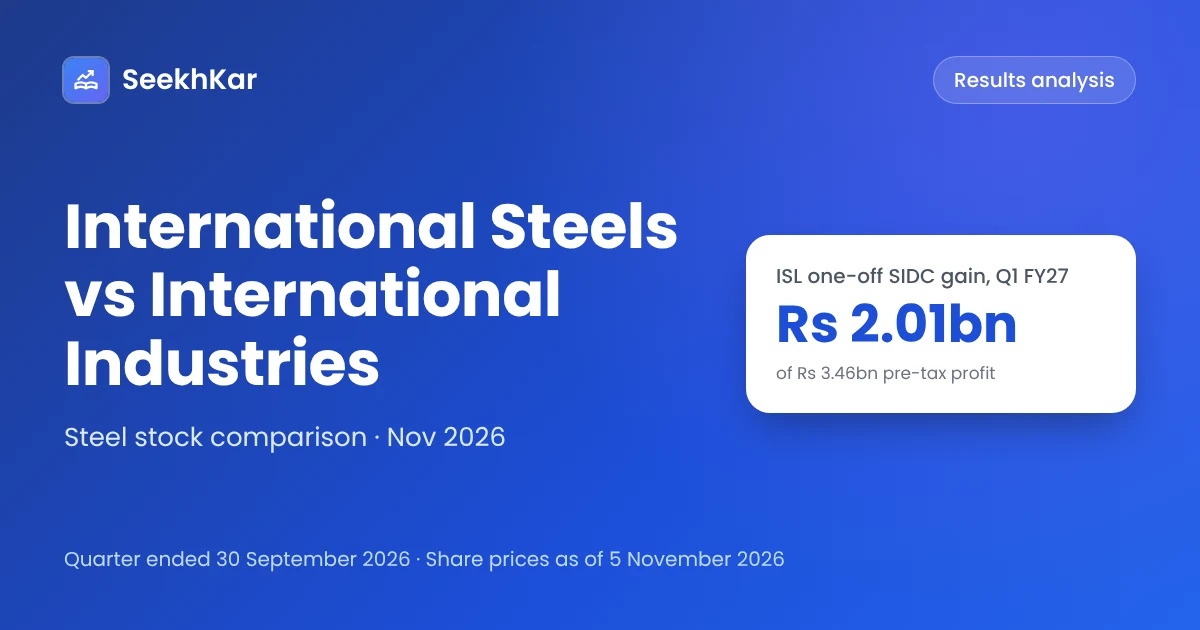
- ISL's Q1 FY27 profit rose to Rs 2.21 billion, but Rs 2.01 billion of its pre-tax profit was a one-off gain on settling the Sindh Infrastructure Development Cess (SIDC).
- Without that gain, ISL's pre-tax profit was about Rs 1.45 billion, up 48% on a year earlier.
- INIL owns 56.33% of ISL. At ISL's share price that stake is worth about Rs 20.3 billion, roughly INIL's whole market value.
- On its own accounts INIL made an operating loss of Rs 44 million in Q1 FY27; its profit came from a Rs 597 million SIDC gain of its own.
PSX retail investor
M Zubair is a retail investor on the Pakistan Stock Exchange. He writes SeekhKar's guides to explain the basics of investing, such as reading annual reports, P/E ratios, dividends and valuation, in simple language for new PSX investors. Everything here is for learning, not investment advice.
International Steels vs International Industries: Valuation at a Glance
International Steels (ISL) makes flat steel: cold-rolled, galvanised and colour-coated coils and sheets. International Industries (INIL) makes steel and plastic pipes and owns 56.33% of ISL, so its consolidated results include ISL's. Both are Chinoy group companies and end their year on 30 June. Prices are PSX closing prices on 5 November 2026.
Earnings are trailing twelve months (TTM): FY26 EPS, minus Q1 FY26, plus Q1 FY27. INIL's figures are consolidated, for its shareholders.
| Metric | ISL | INIL |
|---|---|---|
| Share price, 5 Nov 2026 | Rs 82.65 | Rs 153.03 |
| Market capitalisation | Rs 36 bn | Rs 20 bn |
| EPS, Q1 FY27 | Rs 5.07 | Rs 12.59 |
| EPS, TTM | Rs 12.08 | Rs 31.97 |
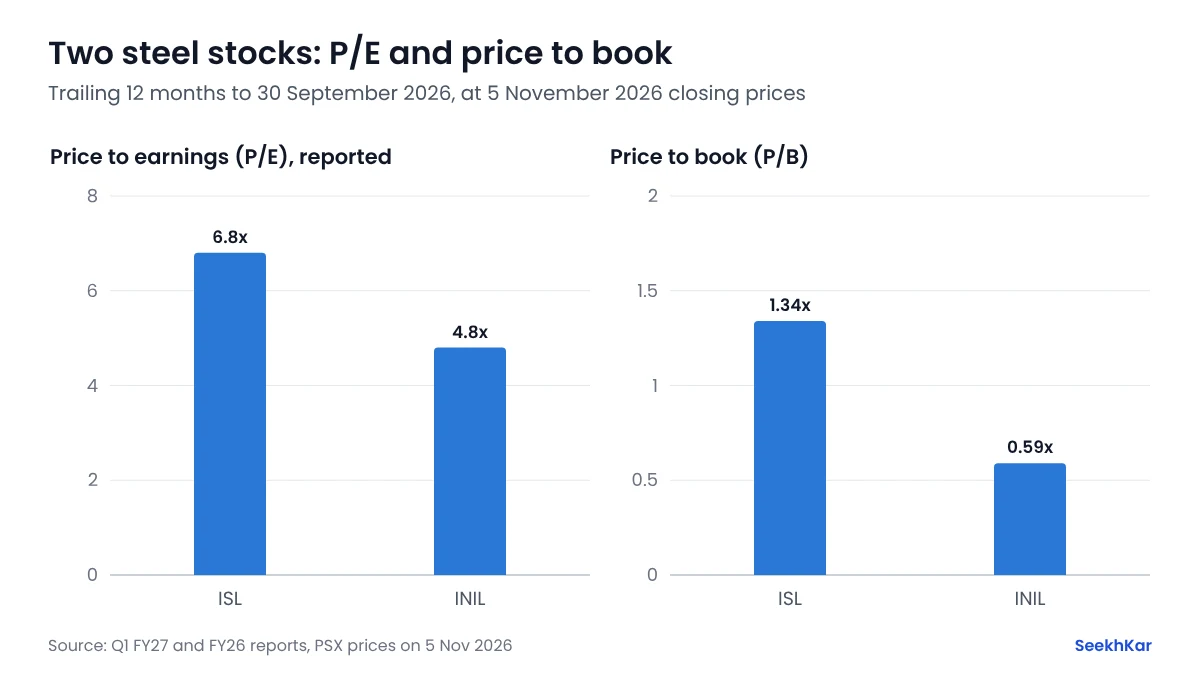
| P/E, TTM | 6.8x | 4.8x |
| P/E without ISL's one-off gain | 9.0x | n/a |
| Book value per share, 30 Jun 2026 | Rs 61.63 | Rs 257.56 |
| P/B | 1.34x | 0.59x |
| ROE (TTM EPS ÷ book value) | 19.6% | 12.4% |
| Dividend per share, FY26 | Rs 5.00 | Rs 7.00 |
| Dividend yield | 6.0% | 4.6% |
| EPS growth, Q1 FY27 vs Q1 FY26 | +255% | +392% |
| Net debt ÷ equity, 30 Jun 2026 | 0.33x | 0.34x |
Book values and debt are from each company's Q1 FY27 report. The P/E without the one-off assumes ISL's SIDC gain was taxed at the quarter's 36% effective rate, which takes Rs 2.94 off its EPS; INIL's consolidated EPS also includes one-offs, but its report does not split them out. Both EPS growth figures include these gains.
The One-Off SIDC Gain, Explained
ISL's July to September profit jumped to Rs 2.21 billion from Rs 620 million, but most of the jump was not from selling steel. Its other income was Rs 2.07 billion, and Rs 2.01 billion of that was a gain from discounting its settlement liability for the Sindh Infrastructure Development Cess (SIDC), a provincial levy. The directors call it a one-off pre-tax gain. Without it, other income was about Rs 65 million and pre-tax profit about Rs 1.45 billion, against Rs 0.98 billion a year earlier.
INIL booked a similar one-off: about Rs 597 million from remeasuring its own SIDC liability. Without it, INIL made an operating loss of Rs 44 million on its own, as its gross profit fell to Rs 841 million and selling costs rose to Rs 669 million; its report blames supply chain disruptions, higher freight and rising input costs. A year earlier its own profit had included Rs 613 million of dividends from ISL. Our guide to P/E ratios by sector explains why one-off gains make a P/E look cheaper than it is.
Which Steel Stock Is Cheaper?
INIL on the numbers, but look at what you are buying. INIL trades at 4.8 times its consolidated earnings and 0.59 times book. Its 245 million ISL shares are worth about Rs 20.3 billion at ISL's 5 November price, roughly the same as INIL's whole market value of Rs 20.2 billion. In other words, the market is putting almost no value on INIL's own pipe business, which made an operating loss last quarter.
ISL is the direct way to own the steel business. On its reported earnings it trades at 6.8 times; without the SIDC gain, at about 9.0 times. It earns a higher ROE (19.6% against 12.4%) and pays the higher yield. Our guide to finding undervalued stocks on the PSX explains how a holding company's discount works.
Results, Dividends and Debt
| Quarter ended 30 Sep | Revenue, 2026 | 2025 | Profit after tax, 2026 | 2025 |
|---|---|---|---|---|
| ISL | Rs 23.76 bn | Rs 20.92 bn | Rs 2.21 bn | Rs 0.62 bn |
| INIL (consolidated, owners) | Rs 29.70 bn | Rs 27.88 bn | Rs 1.66 bn | Rs 0.34 bn |
- ISL dividends: Rs 5.50 for FY24, Rs 2.50 for FY25, then Rs 2 interim and a Rs 3 final for FY26 (Rs 5 in all). At 5 November prices that is a 6.0% yield, or 5.1% after the 15% tax for filers. FY26 EPS was Rs 8.44, up 136%.
- INIL dividends: Rs 5.50 for FY24, Rs 4 for FY25, then Rs 2 interim and a Rs 5 final for FY26 (Rs 7 in all), a 4.6% yield. Shareholders also approved selling its 17% stake in Chinoy Engineering & Construction for Rs 350 million.
- Debt: ISL had Rs 11.4 billion of borrowings, mostly short-term, against Rs 2.6 billion of cash at 30 June 2026. INIL's consolidated borrowings, including ISL's, were Rs 15.7 billion.
The dividend calculator works out your income after tax from any payout.
Scorecard: ISL or INIL?
We ranked the two companies 1 (best) or 2 on six measures, with equal weight, using reported figures. A lower total is better.
| Company | P/E | P/B | Dividend yield | ROE | EPS growth | Debt | Total |
|---|---|---|---|---|---|---|---|
| International Steels | 2 | 2 | 1 | 1 | 2 | 1 | 9 |
| International Industries | 1 | 1 | 2 | 2 | 1 | 2 | 9 |
- The steel business itself: ISL. The higher ROE and yield, and growth even without the one-off. The risks are steel prices, imports and mostly short-term debt.
- The discount: INIL. Its ISL stake alone is worth about its market value. The risks are a loss-making pipe business last quarter and profits that depend on ISL.
Our engineering sector guide covers the other numbers to check, such as steel prices and the rupee. This comparison is educational and is not a recommendation to buy or sell any stock. Prices change daily, and we update these figures after each quarterly result.