JDW Sugar vs Ibrahim Fibres vs Bannu Woollen vs SS Oil 2026
On 5 November 2026 prices, S.S. Oil Mills scores best on our scorecard: the lowest P/E, 5.4 times, and Q1 FY27 profit up 21%. JDW Sugar is close behind, with the highest yield, 5.5%, and ROE, 25%, but the most debt. Ibrahim Fibres and Bannu Woollen are both loss-making over the last twelve months and pay no dividend.
Key takeaways
- S.S. Oil Mills scores 12 on our six-measure scorecard (lower is better), JDW Sugar 13, and Ibrahim Fibres and Bannu Woollen 17 each.
- JDW's consolidated profit for the nine months to June 2026 rose 46% to Rs 4.96 billion, and it has declared Rs 50 a share in the last twelve months, a 5.5% yield.
- Ibrahim Fibres lost Rs 271 million in the nine months to September 2026, which its directors put mainly down to a Rs 2.05 billion liability under its Sindh cess (SIDC) settlement.
- Bannu Woollen lost Rs 72 million in July to September as dealers put off buying for a late winter, and almost all of its book value is revaluation surplus.
- S.S. Oil Mills' July to September sales rose 54% and its profit 21% to Rs 174 million.
PSX retail investor
M Zubair is a retail investor on the Pakistan Stock Exchange. He writes SeekhKar's guides to explain the basics of investing, such as reading annual reports, P/E ratios, dividends and valuation, in simple language for new PSX investors. Everything here is for learning, not investment advice.
JDW Sugar vs Ibrahim Fibres vs Bannu Woollen vs S.S. Oil: Valuation at a Glance
JDW Sugar Mills (JDWS), Ibrahim Fibres (IBFL), Bannu Woollen Mills (BNWM) and S.S. Oil Mills (SSOM) are four more companies from the KSE-100's "miscellaneous" group. JDW is Pakistan's largest sugar producer and also makes ethanol and power. Ibrahim Fibres makes polyester staple fibre (PSF) and yarn near Faisalabad. Bannu Woollen makes woollen fabric, blankets and shawls. S.S. Oil Mills extracts edible oil and meal from canola, sunflower and soybean seeds at its plant in Vehari. Prices are PSX closing prices on 5 November 2026.
Earnings are trailing twelve months (TTM). Bannu Woollen and S.S. Oil end their year in June, so their TTM EPS is FY26 minus July to September 2025 plus July to September 2026. Ibrahim Fibres ends its year in December: 9M 2026 plus October to December 2025. JDW ends its year in September and has not yet reported the full year, so its TTM runs to 30 June 2026: nine months to June 2026 plus July to September 2025. Dividends are those paid or declared in the last twelve months.
| Metric | JDWS | IBFL | BNWM | SSOM |
|---|---|---|---|---|
| Share price, 5 Nov 2026 | Rs 904.29 | Rs 251.35 | Rs 60.02 | Rs 412.32 |
| Market capitalisation | Rs 52 bn | Rs 78 bn | Rs 0.57 bn | Rs 2.3 bn |
| EPS, TTM | Rs 162.28 | −Rs 3.00 | −Rs 22.74 | Rs 76.36 |
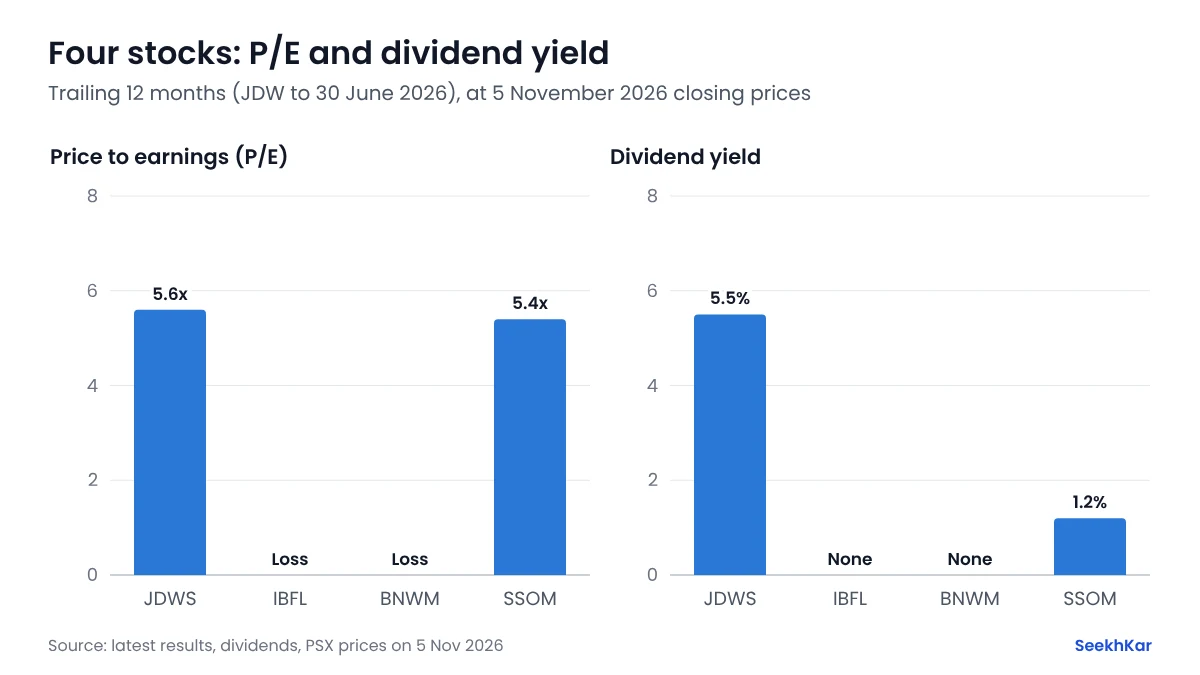
| P/E, TTM | 5.6x | Loss | Loss | 5.4x |
| Book value per share, 30 Jun 2026 | Rs 651.75 | Rs 183.16 | Rs 340.14 | Rs 446.83 |
| P/B | 1.39x | 1.37x | 0.18x | 0.92x |
| ROE (TTM EPS ÷ book value) | 24.9% | −1.6% | −6.7% | 17.1% |
| Dividends, last 12 months | Rs 50 | None | None | Rs 5 |
| Dividend yield | 5.5% | 0% | 0% | 1.2% |
| EPS growth, latest results | +46% | To a loss | To a loss | +21% |
| Net debt ÷ equity, 30 Jun 2026 | 2.33x | 0.30x | 0.13x | 0.59x |
Latest results are the nine months to June 2026 for JDW, the nine months to September 2026 for Ibrahim Fibres, and July to September 2026 for Bannu Woollen and S.S. Oil. JDW's figures are consolidated. Book values, debt and cash are from S&P Global data, except S.S. Oil's, which are from its FY26 annual report. JDW's borrowing swings with the cane-crushing season: Rs 61.6 billion at 31 December 2025, Rs 102.2 billion at 31 March 2026 and Rs 89.4 billion at 30 June 2026.
Which Stock Is Cheapest?
S.S. Oil Mills and JDW, on earnings. S.S. Oil trades at 5.4 times trailing earnings and 0.92 times book value. JDW trades at 5.6 times earnings and 1.39 times book, and it earns a 25% return on its book, the highest of the four.
Bannu Woollen looks cheapest on book value, at 0.18 times, but that is misleading. Rs 3.05 billion of its Rs 3.23 billion book value is revaluation surplus on property, about half of it its share of an associate company's surplus, and it has made losses in each of the last two years. Ibrahim Fibres trades at 1.37 times book with a loss over the last twelve months. Our guide to finding undervalued stocks on the PSX explains why a low P/B can be a value trap.
Latest Results: JDW, Ibrahim Fibres, Bannu Woollen and S.S. Oil
| Company | Period | Revenue (change) | Profit after tax (change) |
|---|---|---|---|
| JDW Sugar | 9M to Jun 2026 | Rs 94.20 bn (−5%) | Rs 4.96 bn (+46%) |
| Ibrahim Fibres | 9M 2026 | Rs 81.78 bn (+5%) | −Rs 271 m (Rs 1.59 bn) |
| Bannu Woollen | Q1 FY27 | Rs 104 m (−56%) | −Rs 72 m (Rs 24 m) |
| S.S. Oil Mills | Q1 FY27 | Rs 4.65 bn (+54%) | Rs 174 m (+21%) |
Figures in brackets for the loss-makers are the profit a year earlier.
- JDW Sugar: revenue for the nine months to June fell about 5%, but consolidated profit after tax rose 46% to Rs 4.96 billion (EPS Rs 85.82). The gain came in October to March; April to June EPS was Rs 1.97, against Rs 12.46. Its half-year report notes that the State Bank raised its policy rate by one percentage point on 27 April 2026 and that more increases are expected.
- Ibrahim Fibres: sales rose 5% and gross profit 4%, but PSF output fell 12% to 162,452 tonnes and pre-tax profit fell to Rs 391 million from Rs 2.69 billion. The directors say the loss is mainly due to a Rs 2.05 billion liability recognised under its settlement of the Sindh Infrastructure Development Cess (SIDC), the provincial levy that also affected our International Steels comparison. In July to September alone it earned Rs 632 million (EPS Rs 2.04), against Rs 152 million. The directors also say PSF, yarn and fabric are being dumped into Pakistan.
- Bannu Woollen: sales fell 56% because dealers delayed lifting its products for a late winter, which left a gross loss, and its unsold stock rose to Rs 1.06 billion. Management expects sales to recover in October to December. In FY26 sales rose 34% to Rs 1.29 billion, but it lost Rs 121 million (EPS −Rs 12.70).
- S.S. Oil Mills: sales rose 54% and profit after tax 21% (EPS Rs 30.72, against Rs 25.30). In FY26 sales rose 75% to Rs 13.68 billion and profit 60% to Rs 401 million.
Dividend History and Yield
- JDW Sugar pays two or three times a year. For FY25 it paid Rs 45 (a Rs 20 interim and a Rs 25 final, paid in January 2026), after Rs 50 for FY24. For FY26 it has paid Rs 20 and Rs 5 interims so far, in May and June 2026. The last twelve months' Rs 50 is a 5.5% yield, or 4.7% after the 15% tax for filers.
- Ibrahim Fibres last paid a dividend of Rs 2 in October 2021 and declared none with its 2026 results.
- Bannu Woollen last paid a dividend for the year to June 2018 (25%, or Rs 2.50 a share). It declared none for FY26 or with its Q1 FY27 results.
- S.S. Oil Mills paid Rs 5 for FY26 (entitlement date 21 October 2026), the same as for FY25. That is a 1.2% yield, or 1.0% after tax.
At 5 November prices, Rs 100,000 in JDW would earn about Rs 4,700 a year after tax at its last-twelve-month payout. The dividend calculator works this out for any stock and amount.
Scorecard: Which Stock?
We ranked the four companies 1 (best) to 4 on six measures, with equal weight. A lower total is better. On P/E, the two loss-makers rank below the profitable pair, ordered by the size of the loss against the share price.
| Company | P/E | P/B | Dividend yield | ROE | EPS growth | Debt | Total |
|---|---|---|---|---|---|---|---|
| S.S. Oil Mills | 1 | 2 | 2 | 2 | 2 | 3 | 12 |
| JDW Sugar | 2 | 4 | 1 | 1 | 1 | 4 | 13 |
| Ibrahim Fibres | 3 | 3 | 3 | 3 | 3 | 2 | 17 |
| Bannu Woollen | 4 | 1 | 3 | 4 | 4 | 1 | 17 |
- Value: S.S. Oil Mills. The lowest P/E, a price below book and rising profit. The risks are its small size (a market value of about Rs 2.3 billion), thinly traded shares, a 1.2% yield and Rs 1.56 billion of short-term borrowing.
- Income: JDW Sugar. A 5.5% yield and a 25% ROE. The risks are the most debt of the four, a weak April to June quarter, rising interest rates and government policy on sugar.
- Recovery: Ibrahim Fibres. Back in profit in July to September. The risks are a twelve-month loss, no dividend since 2021 and cheap imports.
- Bannu Woollen ranks first on P/B and debt only because its book value is almost all revaluation surplus; without it, the company would look far more expensive and indebted. It has lost money in each of the last two years.
With this post we have compared every company in the KSE-100's miscellaneous group except Pakistan Services (PSEL), whose latest results on PSX are for the nine months to March 2025. Our other mixed post compares Shifa, Service Industries, PIBTL and Javedan, and our miscellaneous sector guide covers the whole group. This comparison is educational and is not a recommendation to buy or sell any stock. Prices change daily, and we update these figures after each quarterly result.