Halal Stocks in Pakistan: A KMI-30 Shariah Investing Guide
Halal stocks in Pakistan are shares of companies that pass Shariah screening of their business and finances. The PSX applies six tests, and the companies that pass form the KMI All Share Index, which held 313 companies on 27 October 2026. The KMI-30 tracks 30 large, liquid companies from that list, led by Fauji Fertilizer, Engro Holdings and Meezan Bank.
Key takeaways
- A Shariah-compliant company must pass six tests: a permissible business and five financial ratios, including interest-bearing debt below 33% of total assets since the SECP approved a tighter limit in February 2026.
- On 27 October 2026 the KMI All Share Index held 313 compliant companies and the KMI-30 closed at 235,633.52, according to the PSX Data Portal.
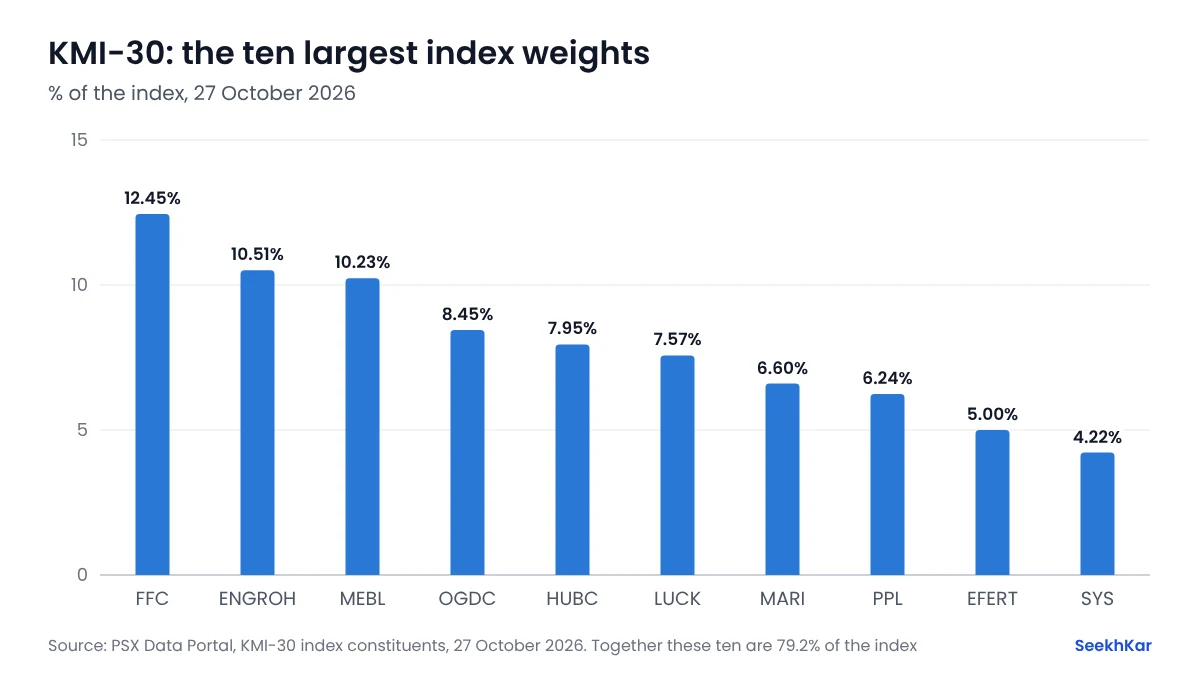
- The ten largest KMI-30 constituents made up 79.2% of the index, led by Fauji Fertilizer (12.45%), Engro Holdings (10.51%) and Meezan Bank (10.23%).
- You purify only the non-compliant share of a dividend, and zakat is a separate obligation.
- Shariah compliance tells you a share is permissible to own, not that its price is reasonable.
PSX retail investor
M Zubair is a retail investor on the Pakistan Stock Exchange. He writes SeekhKar's guides to explain the basics of investing, such as reading annual reports, P/E ratios, dividends and valuation, in simple language for new PSX investors. Everything here is for learning, not investment advice.
Is Investing in Shares Halal?
Many Pakistani Muslims ask this before they invest. Most contemporary scholars consider owning shares of companies whose business and finances meet Shariah principles to be permissible, because a share is part-ownership of a real business rather than a loan earning interest.
Not every company qualifies. Businesses built on interest (conventional banks, insurers and leasing companies) or on prohibited activities such as alcohol and gambling are excluded. So are companies that rely too heavily on interest-bearing debt or interest income. The Shariah-compliant indices on the Pakistan Stock Exchange (PSX) apply these tests for you.
How Do the KMI-30 and KMI All Share Indices Work?
The PSX screens every listed company against six Shariah tests. The KMI All Share Index includes every company that passes. On 27 October 2026 it had 313 constituents and closed at 64,521.14, according to the PSX Data Portal.
The KMI-30 tracks up to 30 large, liquid companies from that compliant list, weighted by free float (the shares available to the public). It closed at 235,633.52 on 27 October 2026, and every one of its 30 constituents was also in the KMI All Share Index. The screening methodology was developed by the PSX with Al Meezan Investment Management, and the KMI-30 is recomposed twice a year.
Compliance is not permanent. A company that fails a test at the next review leaves the indices. Check the current constituent list on the PSX Data Portal rather than relying on any article, including this one.
What Are the Six Shariah Screening Tests?
Under the PSX methodology a company must pass all six tests:
| Test | Requirement |
|---|---|
| 1. Business | The core business must not violate Shariah principles. This excludes interest-based finance (conventional banks, insurance, leasing) and businesses such as alcohol, pork and gambling. |
| 2. Interest-bearing debt | Below 33% of total assets. The limit was 37% until the SECP approved the lower figure in February 2026. |
| 3. Non-compliant investments | Below 33% of total assets: conventional deposits, bonds, T-bills, conventional funds and similar instruments. |
| 4. Non-compliant income | Below 5% of total revenue, including interest income and income from prohibited activities. |
| 5. Illiquid assets | At least 25% of total assets, such as property, plant, equipment and inventory. |
| 6. Net liquid assets | The share price must be at least equal to net liquid assets per share: (total assets − illiquid assets − long-term liabilities − current liabilities) ÷ shares outstanding. |
A company that passes today can fail at the next review if it takes on more conventional debt or its income mix changes, so the result is a snapshot, not a permanent label.
Which Companies Are in the KMI-30 Today?
On 27 October 2026 the ten largest KMI-30 constituents accounted for 79.2% of the index:
| Company (ticker) | Index weight |
|---|---|
| Fauji Fertilizer Company (FFC) | 12.45% |
| Engro Holdings (ENGROH) | 10.51% |
| Meezan Bank (MEBL) | 10.23% |
| Oil and Gas Development Company (OGDC) | 8.45% |
| The Hub Power Company (HUBC) | 7.95% |
| Lucky Cement (LUCK) | 7.57% |
| Mari Energies (MARI) | 6.60% |
| Pakistan Petroleum (PPL) | 6.24% |
| Engro Fertilizers (EFERT) | 5.00% |
| Systems Limited (SYS) | 4.22% |
Fertiliser, energy and cement companies dominate. Meezan Bank is the only bank in the KMI-30, because it is an Islamic bank. Large conventional banks such as HBL and MCB Bank are not in the index, however profitable they are, because they fail the business test. For a closer look at the bank's latest numbers, see our comparison of Meezan Bank with UBL, HBL and MCB.
Why Do Conventional Banks Fail the Business Test?
The first test excludes conventional banks because their core business is lending and borrowing at interest. Islamic banks use contracts such as Murabaha, Ijarah, Diminishing Musharakah and sukuk instead, so they can pass. That is why an Islamic bank can be one of the largest KMI-30 constituents while conventional banks are absent.
The financial tests catch companies whose business is permissible but whose balance sheet is not. A cement maker funded mainly by conventional bank loans can fail the debt test, and a company holding most of its cash in conventional deposits can fail the investments test.
How Do You Purify Dividends?
Even a compliant company can earn a small amount of non-compliant income, usually profit on conventional bank balances. Many scholars ask investors to give that share of their dividend to charity. You purify only the non-compliant portion, not the whole dividend:
- Find the company's non-compliant income ratio in its Shariah compliance disclosures or the index screening data.
- Multiply the dividend you received by that ratio. For illustration, Rs 10,000 of dividends × 2% non-compliant income = Rs 200 to purify.
- Give that amount to charity without counting it as zakat, and keep a record of dividends received and amounts purified.
Scholars differ on the details, so confirm the method with the scholar or fund Shariah adviser you follow.
How Is Zakat Calculated on Shares?
Scholars use two main approaches. The simpler one is to pay 2.5% of the market value of your shares on your zakat date: for illustration, a portfolio worth Rs 1,000,000 gives zakat of Rs 25,000. The other is to pay on your share of each company's zakatable assets (mainly cash, receivables and inventory) rather than its full market value. That usually gives a lower figure but needs the company's balance sheet.
Many long-term investors use the second approach and traders the first, but scholars differ, so ask the one you follow. Zakat is separate from purification: purification is not zakat, and zakat does not replace purification.
How to Value Halal Stocks Before Buying
Shariah compliance tells you a company is permissible to own, not that its price is fair. The same valuation methods apply as for any share:
- Graham Number for mature, profitable companies: √(22.5 × EPS × book value per share). See what is the Graham Number?
- P/E against the sector median, remembering that a low P/E can signal problems. See P/E by sector.
- Dividend yield with a payout check, so a high yield is backed by earnings. See dividend investing in Pakistan.
Then insist on a margin of safety, so a mistake in your estimate does not turn into a loss.
Shariah-Compliant Funds
If you would rather not pick individual stocks, Shariah-compliant equity and index funds hold baskets of compliant shares. Compare their total expense ratio and past performance against the KMI-30, and read the fund's Shariah adviser report to see how it screens and purifies.