Best Investment in Pakistan: Gold vs PSX vs Bank vs Dollar
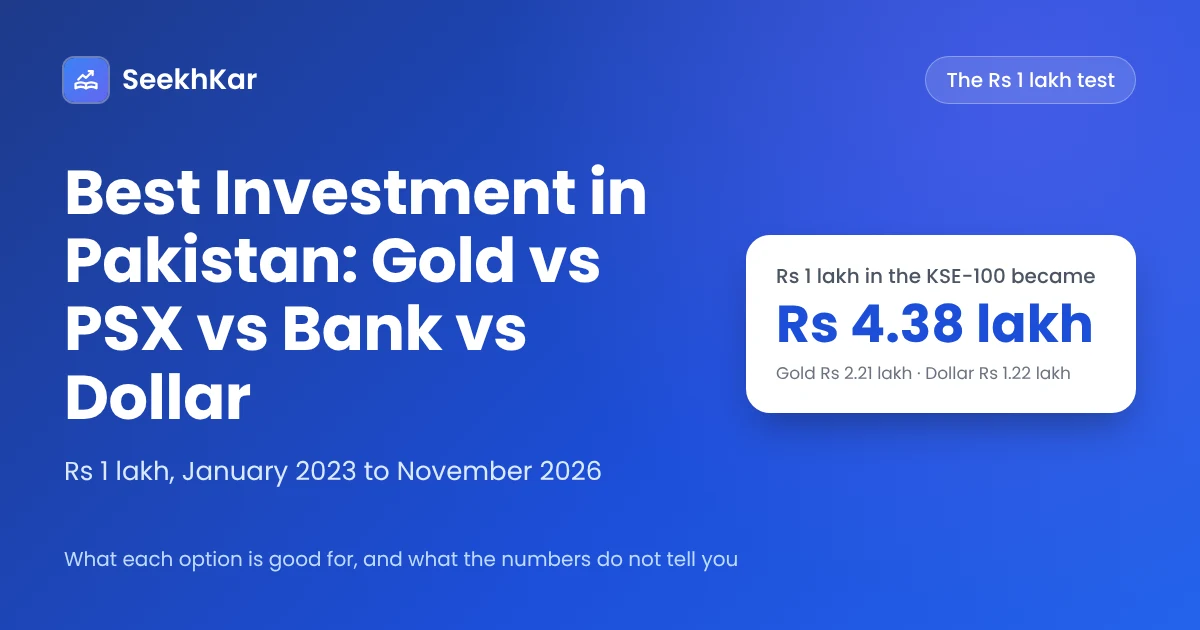
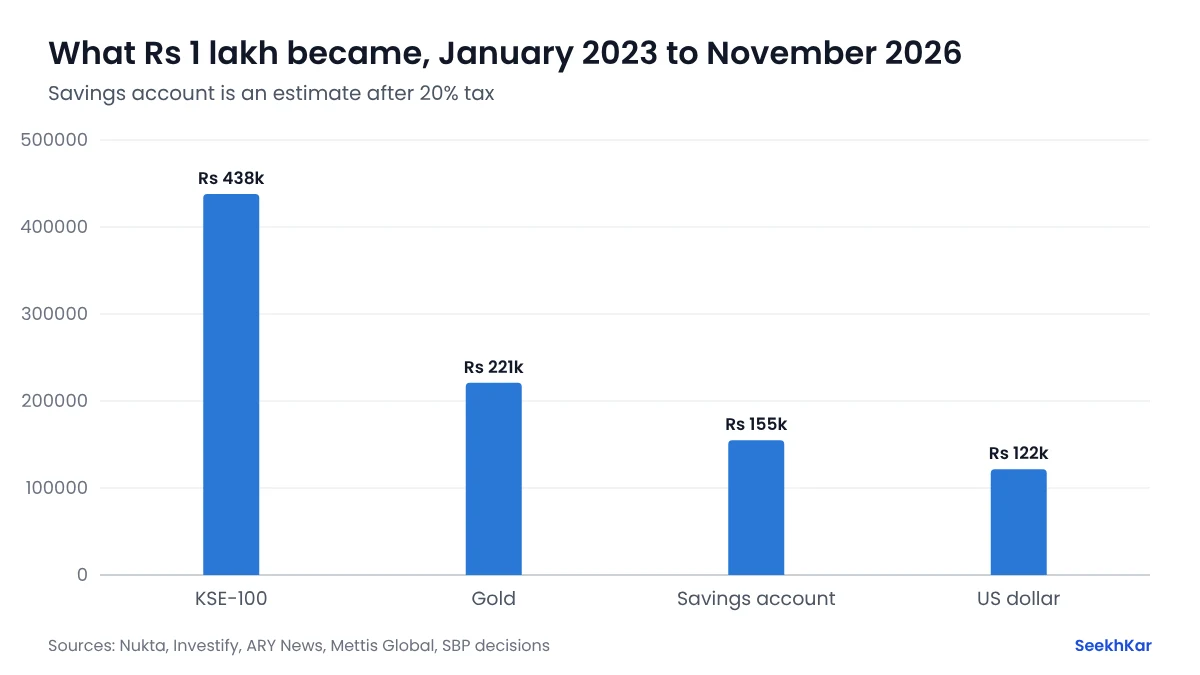
Over January 2023 to November 2026, the KSE-100 turned Rs 1 lakh into about Rs 4.38 lakh, gold into Rs 2.21 lakh, a savings account into roughly Rs 1.55 lakh after tax, and dollars into Rs 1.22 lakh. Shares won because they started cheap as interest rates peaked; the best investment still depends on your goal and timeline.
Key takeaways
- Rs 1 lakh in the KSE-100 in January 2023 would be about Rs 4.38 lakh on 12 November 2026, the best result of the four.
- The same Rs 1 lakh in 24-karat gold would be about Rs 2.21 lakh, in a savings account roughly Rs 1.55 lakh after a 20% tax, and in dollars Rs 1.22 lakh.
- Shares did best because they started from a low point while interest rates were at a record 22%; when rates fell, share prices re-rated.
- Each option has a job: a bank account for money you may need soon, shares for long-term growth, and gold or dollars as a hedge against the rupee.
- Past returns depend heavily on the start date. A different three years could rank these four differently.
PSX retail investor
M Zubair is a retail investor on the Pakistan Stock Exchange. He writes SeekhKar's guides to explain the basics of investing, such as reading annual reports, P/E ratios, dividends and valuation, in simple language for new PSX investors. Everything here is for learning, not investment advice.
The Rs 1 Lakh Test: Gold vs PSX vs Bank vs Dollar
Every Pakistani saver faces the same question: where should my money go? Gold, the stock market, a bank account or dollars? Instead of opinions, here is what actually happened to Rs 100,000 put into each of them in early January 2023 and checked on 12 November 2026, a little under four years later.
| Where Rs 1 lakh went | Then → now | Worth now |
|---|---|---|
| KSE-100 index | 40,504 → 177,374 | Rs 437,917 |
| Gold (24k, per tola) | Rs 188,600 → Rs 416,536 | Rs 220,857 |
| Savings account* | — | ~Rs 155,000 |
| US dollar | Rs 227.41 → Rs 276.39 | Rs 121,538 |
The KSE-100 figure uses the index level on 9 January 2023 and in the afternoon of 12 November 2026. Gold uses the rate of 5 January 2023 and 12 November 2026, and the dollar uses the interbank rate on 9 January 2023 and 12 November 2026. *The savings account figure is an estimate after a 20% tax, explained below.
In yearly terms, the KSE-100 grew about 47% a year, gold about 23%, a savings account about 15% before tax, and the dollar about 5%.
Why the Stock Market Won This Time
January 2023 was one of the worst moments in years to feel good about Pakistani shares, and that is exactly why they did so well. Interest rates were heading to a record 22%, the rupee was falling, and shares were cheap. Over the following three years interest rates fell from 22% to 10.5%. When rates fall, a bank deposit pays less, so investors move money into shares and are willing to pay more for each rupee of company profit.
The result was one of the biggest rallies anywhere: the KSE-100 rose from 40,504 points in January 2023 to 185,557 points in January 2026, and the number of PSX companies worth more than $1 billion rose from 3 to 19. We look at which stocks led that rally, and what they had in common, in our guide to finding multibagger stocks on the PSX.
The lesson is not "shares always win". It is that shares bought when they are cheap and unloved have done best, and that the start date matters a great deal.
Gold: It Doubled, but Mostly Because the Rupee Fell
Gold more than doubled, from Rs 188,600 to Rs 416,536 a tola. Much of that is the rupee, not gold: gold is priced in dollars, so when the rupee loses value the rupee price of gold rises even if the world price does not move.
Gold's strengths are that it is easy to understand, holds value through a currency crisis and can be sold anywhere. Its weaknesses are that it pays no income, jewellery carries making charges you do not get back, and storing it safely costs money or worry. It also moves in big swings: buying at a peak can mean waiting years to break even.
Bank Savings: Steady and Safe, but Taxed
A savings account grows steadily and you can take your money out at any time, which is why it is the right place for an emergency fund. The rate it pays follows the State Bank's policy rate. To estimate what Rs 1 lakh earned, we assumed an account paying 1.5 percentage points below the policy rate, with profit added monthly, through every SBP decision in the period: a record 22% for about a year, eight cuts down to 10.5% by December 2025, and two increases back to 12% in October 2026.
On that basis, Rs 1 lakh grew to about Rs 1.73 lakh before tax, and about Rs 1.55 lakh after a 20% tax on the profit, which is the rate for filers on the Active Taxpayers List today. Your own result depends on your bank's rate and the tax rate in each year. To work out your own figures, use our savings account profit calculator or, for a fixed term, the FD calculator.
Dollars: The Weakest of the Four
Buying dollars felt like the safe choice in January 2023, when the rupee was falling fast. It did protect your money from the rupee, but only just: Rs 1 lakh of dollars became Rs 121,538, a gain of about 22% in almost four years. After the rupee steadied, holding dollars earned nothing, while every other option kept growing.
Dollars can make sense if you have a future cost in dollars, such as foreign study fees. As an investment on their own, they only pay off when the rupee falls sharply.
So What Is the Best Investment in Pakistan for You?
There is no single best investment. There is a best place for each part of your money, depending on when you will need it:
| Your goal | Better fit | Why |
|---|---|---|
| Emergency fund, money needed within a year | Savings account | Safe and you can withdraw any day |
| Saving for 2–3 years with a known date | Term deposit or T-bills | Fixed rate, little risk |
| Growing wealth over 5+ years | Shares or equity funds | Highest long-run growth, but can fall sharply on the way |
| Protecting against a rupee crisis | Some gold | Rises when the rupee falls, but pays no income |
| A future cost in dollars | Dollars | Matches the currency you will spend |
Many people split their money: an emergency fund in the bank first, then a regular monthly amount into shares or an equity fund, and perhaps a small part in gold. Investing a fixed amount every month means you buy more when prices are low, which takes some of the guesswork out of timing. Our guide to dividend stocks on the PSX is a good next step if you want shares that also pay an income, and our guide on how to apply for an IPO in Pakistan explains how to buy shares in a company as it lists.
This article compares past results and is for education only. It is not advice to buy or sell any asset, and past returns, especially from one strong period, do not tell you what will happen next.
Sources & Further Reading
- Nukta: Pakistan stock market emerges as major wealth creator (KSE-100 in January 2023 and 2026; rates from 22% to 10.5%)
- Investify / Profit: market snapshot on 12 November 2026 (KSE-100, USD/PKR, gold per tola)
- ARY News: gold price per tola, 5 January 2023
- Mettis Global: PKR interbank rate, 9 January 2023
- Pakistan Observer: SBP policy rate timeline, March 2024 to October 2026