LUCK vs FCCL vs MLCF vs DGKC: Best Cement Stock 2026
On 29 October 2026 prices, Fauji Cement (FCCL) narrowly scores best of four KSE-100 cement stocks: 7.2 times trailing earnings, the highest dividend yield (2.9%) and 51% first-quarter EPS growth. DG Khan Cement is cheapest at 6.5 times earnings and 0.65 times book, Lucky Cement has net cash, and Maple Leaf carries the most debt.
Key takeaways
- Fauji Cement (FCCL) scores best on our six-measure scorecard, just ahead of Lucky and DG Khan: 7.2 times earnings, a 2.9% dividend yield and Q1 FY27 EPS up 50.7%.
- DG Khan Cement (DGKC) is the cheapest at 6.5 times earnings and 0.65 times book value, but it earns the lowest return on equity of the four (10.0%).
- Lucky Cement (LUCK) has the highest ROE (20.7%) and more cash than debt, but group EPS fell 1.7% in Q1 FY27 as its share of profit from joint ventures and associates dropped 24.8%.
- Maple Leaf (MLCF) more than doubled gross profit after buying Pioneer Cement, but finance costs rose six-fold on the deal's debt and its standalone EPS fell 18%.
- Northern mills exported no cement in Q1 FY27 with the Afghan border closed; Pakistan's local sales rose 7.8% while exports fell 11.3%, all of them shipped from the south.
PSX retail investor
M Zubair is a retail investor on the Pakistan Stock Exchange. He writes SeekhKar's guides to explain the basics of investing, such as reading annual reports, P/E ratios, dividends and valuation, in simple language for new PSX investors. Everything here is for learning, not investment advice.
LUCK vs FCCL vs MLCF vs DGKC: Valuation at a Glance
Lucky Cement (LUCK), Fauji Cement Company (FCCL), Maple Leaf Cement Factory (MLCF) and D.G. Khan Cement Company (DGKC) are four cement stocks in the KSE-100 index. All four end their financial year on 30 June, so their results for the quarter ended 30 September 2026 (Q1 FY27) cover the same three months. Prices are PSX closing prices on 29 October 2026.
Earnings are trailing twelve months (TTM): FY26 EPS, minus Q1 FY26, plus Q1 FY27. Dividends are each company's dividend for FY26, the only ones any of them declared in the last twelve months.
| Metric | Lucky (LUCK) | Fauji (FCCL) | Maple Leaf (MLCF) | DG Khan (DGKC) |
|---|---|---|---|---|
| Share price, 29 Oct 2026 | Rs 397.01 | Rs 52.61 | Rs 91.03 | Rs 182.00 |
| Market capitalisation | Rs 582 bn | Rs 129 bn | Rs 95 bn | Rs 80 bn |
| EPS, Q1 FY27 | Rs 14.76 | Rs 2.02 | Rs 3.54 | Rs 6.02 |
| EPS, TTM | Rs 60.53 | Rs 7.28 | Rs 12.28 | Rs 28.03 |
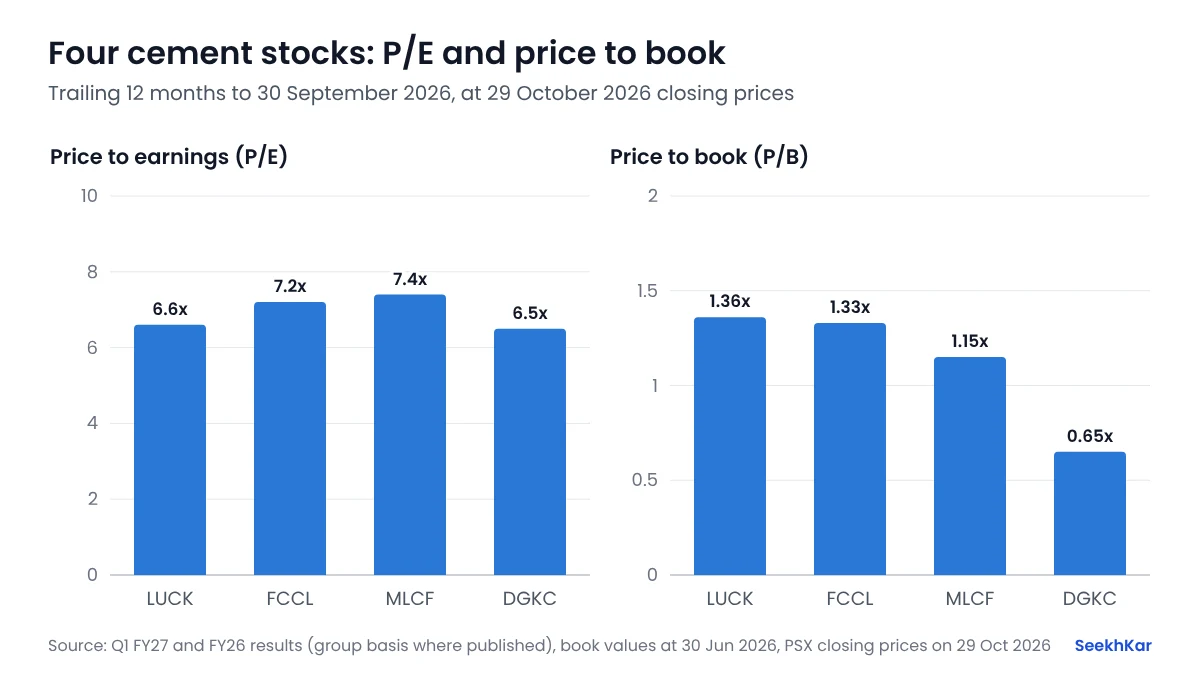
| P/E, TTM | 6.6x | 7.2x | 7.4x | 6.5x |
| Book value per share, 30 Jun 2026 | Rs 292.50 | Rs 39.70 | Rs 79.23 | Rs 280.25 |
| P/B | 1.36x | 1.33x | 1.15x | 0.65x |
| ROE (TTM EPS ÷ book value) | 20.7% | 18.3% | 15.5% | 10.0% |
| Dividend per share, FY26 | Rs 5.00 | Rs 1.50 | None | Rs 1.00 |
| Dividend yield | 1.3% | 2.9% | 0.0% | 0.5% |
| EPS growth, Q1 FY27 vs Q1 FY26 | −1.7% | +50.7% | +36.2% | +21.1% |
| Net debt ÷ equity, 30 Jun 2026 | Net cash | 0.31x | 0.73x | 0.05x |
Earnings are consolidated (group) figures for Lucky, Maple Leaf and DG Khan, because the group is what a shareholder owns; Fauji Cement's figures are as it reported them. Book values are equity attributable to shareholders at 30 June 2026, from S&P Global data, the latest date available for all four. Net debt is total borrowings minus cash on the same date.
Which Cement Stock Is Cheapest on P/E and P/B?
DG Khan Cement is the cheapest on both measures. At Rs 182.00 it trades at 6.5 times trailing earnings and 0.65 times book value, so the market values the company at about two-thirds of the equity in its accounts. Lucky Cement is almost as cheap on earnings (6.6 times), Fauji is at 7.2 and Maple Leaf is the most expensive at 7.4. All four trade below the 8 to 12 times range our cement sector guide uses as a benchmark.
The P/B ranking follows return on equity. Lucky earns 20.7% a year on its shareholders' equity and trades at 1.36 times book; DG Khan earns 10.0% and trades at 0.65 times. A low P/B is a bargain only if the return on that equity improves, so check ROE before treating DG Khan's discount to book as a margin of safety.
The basis matters most for Lucky. On its own (standalone) accounts, Lucky Cement earned Rs 33.54 a share over the last twelve months against Rs 60.53 for the group, because its power, chemicals and car businesses earn a large share of the profit. That puts Lucky at 11.8 times standalone earnings, the basis the PSX Data Portal uses. DG Khan's standalone P/E is 6.9. Our guide to P/E ratios by sector explains how to compare P/E across sectors.
Q1 FY27 Results: Which Cement Company Grew Fastest?
| Company | Revenue, Q1 FY27 | Change | Profit after tax, Q1 FY27 | Q1 FY26 | Change | EPS, Q1 FY27 | EPS, Q1 FY26 |
|---|---|---|---|---|---|---|---|
| Lucky Cement | Rs 131.86 bn | +5.3% | Rs 22.56 bn | Rs 23.56 bn | −4.3% | Rs 14.76 | Rs 15.01 |
| Fauji Cement | Rs 26.05 bn | +11.2% | Rs 4.96 bn | Rs 3.29 bn | +50.9% | Rs 2.02 | Rs 1.34 |
| Maple Leaf | Rs 30.92 bn | +87.6% | Rs 4.21 bn | Rs 2.73 bn | +54.2% | Rs 3.54 | Rs 2.60 |
| DG Khan Cement | Rs 25.05 bn | +16.9% | Rs 2.73 bn | Rs 2.20 bn | +24.1% | Rs 6.02 | Rs 4.97 |
Fauji Cement grew fastest per share. Revenue rose 11.2%, gross margin widened to 35.9% from 31.5%, and finance cost fell 37% to Rs 714 million. It also booked Rs 496 million as its share of profit from its associate Askari Cement. The company credits better retention prices, higher local dispatches and efficiency gains.
Maple Leaf's growth comes from an acquisition. Revenue rose 87.6% and gross profit more than doubled to Rs 12.18 billion because Pioneer Cement, in which it holds about 88%, is now part of the group. But finance cost jumped to Rs 2.47 billion from Rs 0.40 billion on the debt raised to buy it. On Maple Leaf's own accounts, profit fell to Rs 2.14 billion from Rs 2.61 billion and EPS to Rs 2.04 from Rs 2.49.
DG Khan grew on volume. Group EPS rose 21.1%; its own profit rose 7.6% to Rs 2.32 billion (EPS Rs 5.30 against Rs 4.93). AKD Securities estimates its dispatches rose 19% but its gross margin held at about 21.5%, the thinnest of the four, while finance costs rose 78%.
Lucky's cement business grew, but the group did not. Its own profit rose 17.2% to Rs 17.13 billion (EPS Rs 11.69 against Rs 9.98), helped by Rs 9.0 billion of dividends from its subsidiaries and associate. In the group accounts those dividends cancel out, and the share of profit from joint ventures and associates fell 24.8% to Rs 4.06 billion. Our guide to reading PSX annual reports explains standalone and consolidated accounts, using Lucky Cement as the example.
Over the full FY26, DG Khan grew group EPS fastest (+27.9% to Rs 26.98), followed by Fauji (+21.5% to Rs 6.60), Lucky (+15.7% to Rs 60.78) and Maple Leaf (+3.3% to Rs 11.34).
Cement Dispatches: Why Northern Exports Fell to Zero
According to the All Pakistan Cement Manufacturers Association (APCMA), the industry dispatched 13.14 million tonnes of cement and clinker in Q1 FY27, up 3.9%. Local sales rose 7.8% to 10.85 million tonnes, while exports fell 11.3% to 2.30 million tonnes.
| Million tonnes, Q1 FY27 | Local | Change | Exports | Change |
|---|---|---|---|---|
| North | 8.95 | +6.8% | Nil | From 0.66 |
| South | 1.90 | +12.7% | 2.30 | +19.2% |
| Pakistan | 10.85 | +7.8% | 2.30 | −11.3% |
Northern mills used to export by road to Afghanistan, but the border has been closed since mid-October 2025, so in Q1 FY27 every tonne exported left from the south by sea. That split the four companies:
- Lucky Cement has plants in both regions. It dispatched 2.64 million tonnes (+8.0%), about 20% of Pakistan's total, including 0.81 million tonnes of exports (−1.9%) from its Karachi plant.
- DG Khan Cement also has a southern plant, at Hub. AKD Securities estimates its dispatches rose 19% to about 1.6 million tonnes, with exports up about a third.
- Fauji Cement and Maple Leaf sell only from the north, so they had no exports. AKD estimates Fauji's total dispatches fell 3% even as its local sales rose, and Maple Leaf's own dispatches rose 2%.
Prices helped all four. Topline Securities estimated retail cement prices were Rs 100 to Rs 150 a bag higher than a year earlier, which helped offset the rise in imported coal, whose average Richards Bay price climbed to US$113.93 a tonne in the quarter from US$90.30.
Margins, Coal Costs and Debt
| Company | Gross margin, Q1 FY27 | Q1 FY26 | Net cash (debt), 30 Jun 2026 | Total equity | Net debt ÷ equity |
|---|---|---|---|---|---|
| Lucky Cement | 36.8% | 39.2% | Rs 3.2 bn net cash | Rs 473.9 bn | None |
| Fauji Cement | 35.9% | 31.5% | Rs 30.0 bn net debt | Rs 97.4 bn | 0.31x |
| Maple Leaf | 39.4% | 33.9% | Rs 69.0 bn net debt | Rs 94.2 bn | 0.73x |
| DG Khan Cement | 21.5% | 21.7% | Rs 6.2 bn net debt | Rs 126.7 bn | 0.05x |
Gross margins are standalone for Lucky (from its filing) and DG Khan (AKD Securities' figure), and group figures for Maple Leaf; Fauji's are as reported. Lucky's margin narrowed on higher energy, raw material and packing costs. Fauji, citing better retention prices, and Maple Leaf, now including Pioneer, widened theirs.
Maple Leaf carries the most debt. Its net debt rose to Rs 69.0 billion after the Pioneer purchase, about 0.73 times its equity, and its finance cost was six times last year's in Q1 FY27. Lucky's group borrows Rs 185 billion but holds slightly more in cash. DG Khan's net debt is small, and Fauji's is about a third of its equity.
Interest rates now matter more. The State Bank of Pakistan raised its policy rate to 12% from 27 October 2026, which raises the cost of Maple Leaf's debt most and can also slow the construction spending that drives local cement demand.
Capacity, Expansion and Value per Tonne
Pakistani analysts often value cement makers by enterprise value (market value plus net debt and minority interests) per tonne of annual capacity, because building a new plant is the alternative to buying an existing one. A lower figure means you pay less for each tonne the company can make.
| Company | Capacity, million tonnes a year | Enterprise value | EV per tonne |
|---|---|---|---|
| Fauji Cement | 10.46 | Rs 159 bn | Rs 15,200 |
| Maple Leaf with Pioneer | 13.23 | Rs 176 bn | Rs 13,300 |
| DG Khan Cement | 7.06 | Rs 90 bn | Rs 12,700 |
| Lucky Cement | 15.26 | Not comparable | Not comparable |
Capacities are APCMA's figures at 30 June 2025. Lucky is left out because its group value includes power, chemicals and car businesses, which would overstate what investors pay for its cement plants. On this rough yardstick DG Khan is the cheapest and Fauji the most expensive of the three.
- Lucky Cement's board approved a 3.20 million tonne expansion at Karachi on 28 October 2026, which would take its capacity in Pakistan to 18.80 million tonnes, with commercial operations targeted by December 2027.
- Maple Leaf's shareholders approved the scheme to merge Pioneer Cement into the company on 19 October 2026, which would make the two plants one listed company.
- DG Khan Cement is building an 11,000 tonne-a-day line at its DG Khan site, which AHL Research reported as on track.
Which Cement Stock Pays the Highest Dividend?
| Company | FY26 dividend | Ex-date | Yield | Yield after 15% tax | Payout of TTM EPS |
|---|---|---|---|---|---|
| Fauji Cement | Rs 1.50 | 21 Sep 2026 | 2.9% | 2.4% | 21% |
| Lucky Cement | Rs 5.00 | 17 Sep 2026 | 1.3% | 1.1% | 8% |
| DG Khan Cement | Rs 1.00 | 19 Oct 2026 | 0.5% | 0.5% | 4% |
| Maple Leaf | None | None | 0.0% | 0.0% | 0% |
Fauji Cement pays the most, but no cement stock here is an income stock. At 29 October prices, Rs 100,000 invested in Fauji would have earned about Rs 2,420 in dividends over the last year after the 15% withholding tax for filers, against about Rs 1,070 from Lucky and Rs 470 from DG Khan. Maple Leaf has not paid a cash dividend since 2019, and none of the four declared one with its Q1 FY27 results.
Cement companies keep most of their profit to pay for new capacity and repay debt, so their return comes mainly from earnings growth rather than dividends. If dividends are your goal, our guide to dividend investing in Pakistan covers sectors that pay out more.
Scorecard: Which Cement Stock Looks Best Value Today?
We ranked the four companies from 1 (best) to 4 on six measures, with equal weight. A lower total is better.
| Company | P/E | P/B | Dividend yield | ROE | EPS growth | Debt | Total |
|---|---|---|---|---|---|---|---|
| Fauji Cement | 3 | 3 | 1 | 2 | 1 | 3 | 13 |
| Lucky Cement | 2 | 4 | 2 | 1 | 4 | 1 | 14 |
| DG Khan Cement | 1 | 1 | 3 | 4 | 3 | 2 | 14 |
| Maple Leaf | 4 | 2 | 4 | 3 | 2 | 4 | 19 |
- All-round: Fauji Cement. The fastest EPS growth, the highest yield and moderate debt at 7.2 times earnings. The risks are that it sells only in the north, with no exports while the Afghan border stays closed, and that it is the most expensive per tonne of capacity.
- Quality and balance sheet: Lucky Cement. The highest ROE, net cash, the largest exports and a new expansion. The risks are falling profit from the non-cement businesses and a much higher P/E (11.8) on standalone earnings.
- Deep value: DG Khan Cement. The lowest P/E, P/B and value per tonne, with export growth from its southern plant. The risks are the lowest ROE, the thinnest margin and a token dividend.
- Turnaround on debt: Maple Leaf. Pioneer adds scale and its group margin is the widest. The risks are the most debt, a higher interest rate, no dividend and a falling standalone profit.
Cement earnings swing with construction demand, coal prices and interest rates, so a discounted cash flow model built on one good year can overstate value. If you build one, use a mid-cycle margin and cross-check the result against P/B and value per tonne. You can test your assumptions in our DCF calculator.
This comparison is educational and is not a recommendation to buy or sell any stock. Prices change daily, and we update these figures after each quarterly result.
Sources & Further Reading
- Lucky Cement: financial results for the quarter ended 30 Sep 2026 (PSX filing, 29 Oct 2026)
- Mettis Global: Fauji Cement 1QFY27 profit surges 51% to Rs5bn
- Mettis Global: Maple Leaf Cement 1QFY27 consolidated profit Rs4.2bn
- FinHisaab: DG Khan Cement Q1 FY27 consolidated and unconsolidated results
- Mettis Global: cement despatches in September 2026 and 1QFY27 (APCMA data)