Nestle vs Colgate vs Unilever Foods: FMCG Stocks 2026
On 2 November 2026 prices, Colgate-Palmolive Pakistan scores best on our scorecard: it is the cheapest of the three at 15 times earnings and has the most net cash. Nestle pays the highest yield, 8.1%, but paid out more than it earned. Unilever Pakistan Foods grew fastest, with 9M profit up 38%, and McCormick plans to buy control.
Key takeaways
- Colgate-Palmolive Pakistan scores 10 on our six-measure scorecard (lower is better); Nestle Pakistan and Unilever Pakistan Foods tie at 13.
- Nestle paid Rs 566 a share in the last twelve months, an 8.1% yield, but that is 145% of its trailing earnings.
- Unilever Pakistan Foods grew nine-month profit 38% to Rs 6.33 billion and pays out all of its earnings.
- McCormick plans to buy the 76.55% of Unilever Pakistan Foods held by Unilever's Conopco and will make a public offer for more shares.
- Colgate's sales rose 28% in Q1 FY27 but profit only 8%, as its gross margin fell from 35% to 29%.
PSX retail investor
M Zubair is a retail investor on the Pakistan Stock Exchange. He writes SeekhKar's guides to explain the basics of investing, such as reading annual reports, P/E ratios, dividends and valuation, in simple language for new PSX investors. Everything here is for learning, not investment advice.
Nestle vs Colgate vs Unilever Foods: Valuation at a Glance
Nestle Pakistan (NESTLE), Colgate-Palmolive Pakistan (COLG) and Unilever Pakistan Foods (UPFL) are the three largest FMCG (fast-moving consumer goods) companies in the KSE-100: milk, water and cereals; toothpaste, detergents and soap; and Knorr and Rafhan food products. Prices are PSX closing prices on 2 November 2026.
Nestle and Unilever Foods end their financial year on 31 December and Colgate on 30 June. Earnings are trailing twelve months (TTM) to 30 September 2026 for all three: 9M 2026 EPS plus October to December 2025 for Nestle and Unilever Foods, and FY26 EPS minus Q1 FY26 plus Q1 FY27 for Colgate.
| Metric | NESTLE | COLG | UPFL |
|---|---|---|---|
| Share price, 2 Nov 2026 | Rs 6,994.60 | Rs 1,170.50 | Rs 25,998.98 |
| Market capitalisation | Rs 317 bn | Rs 284 bn | Rs 166 bn |
| EPS, TTM | Rs 389.74 | Rs 78.24 | Rs 1,208.78 |
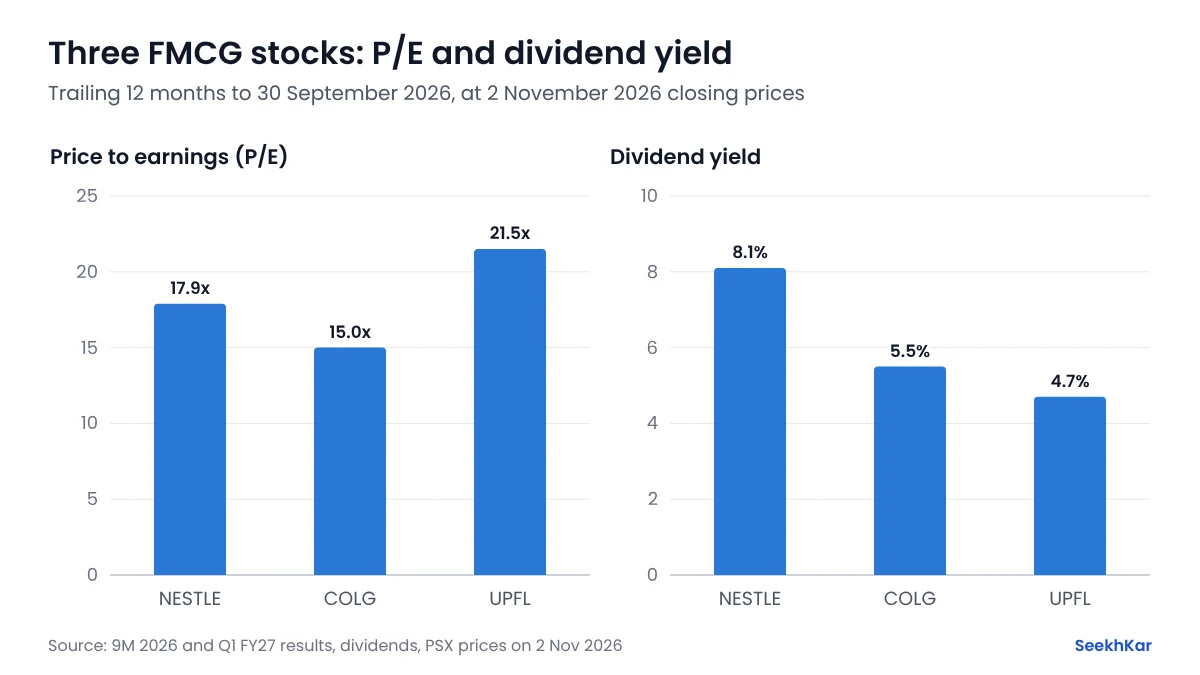
| P/E, TTM | 17.9x | 15.0x | 21.5x |
| Book value per share, 30 Jun 2026 | Rs 433.02 | Rs 171.44 | Rs 1,133.50 |
| P/B | 16.2x | 6.8x | 22.9x |
| ROE (TTM EPS ÷ book value) | 90.0% | 45.6% | 106.6% |
| Dividends, last 12 months | Rs 566 | Rs 64 | Rs 1,209 |
| Dividend yield | 8.1% | 5.5% | 4.7% |
| EPS growth, latest period | +3.1% | +8.0% | +38.3% |
| Net debt ÷ equity, 30 Jun 2026 | 0.16x | −0.64x | −0.42x |
EPS growth is 9M 2026 against 9M 2025, and Q1 FY27 against Q1 FY26 for Colgate. A negative net debt figure means more cash than debt. Book values, debt and cash are from S&P Global data.
Which FMCG Stock Is Cheapest?
Colgate, on every price measure. It trades at 15.0 times trailing earnings, against 17.9 for Nestle and 21.5 for Unilever Foods, and at 6.8 times book value against 16 and 23 times.
Price to book is high for all three because they pay out most of what they earn, so little profit stays in the business as book value. That also makes their ROE very high: Unilever Foods earns more than its whole book value in a year. For these companies P/E and dividend yield say more than P/B. For comparison, our guide to P/E ratios by sector puts banks at a typical 7 to 10 times earnings and cement at 8 to 12.
Latest Results: 9M 2026 and Q1 FY27
| Company | Net sales, 2026 | 2025 | Profit after tax, 2026 | 2025 | Change |
|---|---|---|---|---|---|
| Nestle (9M) | Rs 160.26 bn | Rs 150.82 bn | Rs 14.53 bn | Rs 14.10 bn | +3% |
| Unilever Foods (9M) | Rs 37.60 bn | Rs 30.08 bn | Rs 6.33 bn | Rs 4.57 bn | +38% |
| Colgate (Q1 FY27) | Rs 39.42 bn | Rs 30.86 bn | Rs 4.93 bn | Rs 4.56 bn | +8% |
- Unilever Foods: sales rose 25% and gross profit 38% to Rs 16.13 billion, so profit grew as fast as gross profit.
- Colgate: sales rose 28%, but gross profit rose only 8% to Rs 11.60 billion, so its gross margin fell from 34.8% to 29.4%.
- Nestle: sales rose 6% and gross profit 8% to Rs 61.31 billion, but profit after tax rose only 3%.
Dividend History and Yield
| Company | Last 12 months | Yield | Yield after 15% tax | Payout of TTM EPS |
|---|---|---|---|---|
| Nestle Pakistan | Rs 566 | 8.1% | 6.9% | 145% |
| Colgate | Rs 64 | 5.5% | 4.6% | 82% |
| Unilever Foods | Rs 1,209 | 4.7% | 4.0% | 100% |
- Nestle Pakistan: a Rs 256 final for 2025 (April 2026), then interims of Rs 213 (August 2026) and Rs 97 (declared with its 9M results on 22 October 2026).
- Unilever Foods: a Rs 216 final for 2025 (April 2026), then interims of Rs 331 (May), Rs 350 (September) and Rs 312 (declared on 23 October 2026).
- Colgate: Rs 29 interim (February 2026) and Rs 35 final (September 2026) for FY26.
Nestle pays more than it earns. Its dividends in the last twelve months were 145% of its trailing EPS. Its equity fell from Rs 26.9 billion at 31 March 2026 to Rs 19.6 billion at 30 June, and its debt rose from Rs 1.7 billion to Rs 5.4 billion, so its 8.1% yield depends on cash and borrowing, not only on profit. The dividend calculator shows what any of these payouts are worth after tax.
McCormick's Offer for Unilever Pakistan Foods
On 21 October 2026 McCormick & Company said it intends to acquire at least 76.55% of Unilever Pakistan Foods: the 4,876,294 shares held by Conopco, a Unilever company. It is part of McCormick's deal for Unilever's global food business, agreed on 31 March 2026. Arif Habib Limited is the manager to the offer.
McCormick will also make a public offer to other shareholders, as Pakistan's takeover rules require, but the price and the number of shares have not been announced. The deal needs regulatory approvals, including the Competition Commission of Pakistan, and can still be withdrawn. Unilever Foods closed at Rs 25,352 the day before the notice; the 28-day average price was Rs 25,308.
Scorecard: Best FMCG Stock on the PSX?
We ranked the three companies 1 (best) to 3 on six measures, with equal weight. A lower total is better.
| Company | P/E | P/B | Dividend yield | ROE | EPS growth | Debt | Total |
|---|---|---|---|---|---|---|---|
| Colgate | 1 | 1 | 2 | 3 | 2 | 1 | 10 |
| Nestle Pakistan | 2 | 2 | 1 | 2 | 3 | 3 | 13 |
| Unilever Foods | 3 | 3 | 3 | 1 | 1 | 2 | 13 |
- Value and cash: Colgate. The lowest P/E and P/B, the most net cash and a 5.5% yield. The risk is falling margins: sales grew 28% but profit only 8%.
- Income: Nestle Pakistan. The highest yield at 8.1%. The risks are 3% profit growth and dividends larger than earnings.
- Growth: Unilever Foods. Profit up 38% and the highest ROE. The risks are the highest P/E and an offer whose price is not yet known.
Our food and personal care sector guide lists the other numbers to check, such as input costs and pricing power. This comparison is educational and is not a recommendation to buy or sell any stock. Prices change daily, and we update these figures after each quarterly result.