PSO vs Attock Petroleum (APL): Best OMC Stock 2026
On 29 October 2026 prices, Attock Petroleum (APL) scores better than Pakistan State Oil (PSO) on our scorecard: 3.4 times trailing earnings, an 11.1% dividend yield and more cash than debt. PSO is cheaper on book value (0.58 times) and grew faster, but about Rs 909 billion of receivables, much of it circular debt, ties up its cash.
Key takeaways
- Attock Petroleum scores 8 to PSO's 10 on our six-measure scorecard (lower is better): a P/E of 3.4, an 11.1% dividend yield, a 26% ROE and net cash.
- PSO trades at 0.58 times book value and its first-quarter group EPS nearly tripled to Rs 62.66, as its market share rose to 45.9% from 41.7%.
- PSO's receivables were about Rs 909 billion on 20 July 2026, more than five times its market value; Rs 535 billion was owed by SNGPL for imported LNG.
- APL paid Rs 60 a share in dividends for FY26 and has net cash of about Rs 35 billion, roughly half its market value.
- Both companies' profits rose in Q1 FY27 while fuel prices were far higher than a year earlier. Pakistan's fuel sales grew 6%, but sales excluding furnace oil were flat, so part of this quarter's profit may not repeat.
PSX retail investor
M Zubair is a retail investor on the Pakistan Stock Exchange. He writes SeekhKar's guides to explain the basics of investing, such as reading annual reports, P/E ratios, dividends and valuation, in simple language for new PSX investors. Everything here is for learning, not investment advice.
PSO vs APL: Valuation at a Glance
Pakistan State Oil (PSO) and Attock Petroleum (APL) are the two oil marketing companies (OMCs) in the KSE-100 index; the PSX sector also includes the gas utilities SNGP and SSGC. PSO and APL buy petrol, diesel and other fuels from refineries and importers and sell them through their petrol pumps and to industry and power plants. Both end their financial year on 30 June, so their results for the quarter ended 30 September 2026 (Q1 FY27) cover the same period. Prices are PSX closing prices on 29 October 2026.
Earnings are trailing twelve months (TTM): FY26 EPS, minus Q1 FY26, plus Q1 FY27. Dividends are each company's dividends for FY26, the only ones declared in the last twelve months.
| Metric | Pakistan State Oil (PSO) | Attock Petroleum (APL) |
|---|---|---|
| Share price, 29 Oct 2026 | Rs 360.69 | Rs 542.64 |
| Market capitalisation | Rs 169 bn | Rs 68 bn |
| EPS, Q1 FY27 | Rs 62.66 | Rs 53.36 |
| EPS, TTM | Rs 94.52 | Rs 159.04 |
| P/E, TTM | 3.8x | 3.4x |
| Book value per share | Rs 620.83 (31 Mar 2026) | Rs 606.72 (30 Jun 2026) |
| P/B | 0.58x | 0.89x |
| ROE (TTM EPS ÷ book value) | 15.2% | 26.2% |
| Dividend per share, FY26 | Rs 10.00 | Rs 60.00 |
| Dividend yield | 2.8% | 11.1% |
| EPS growth, Q1 FY27 vs Q1 FY26 | +179% | +74% |
| Net debt ÷ equity | About 1.0x (31 Mar 2026) | Net cash (30 Jun 2026) |
PSO's figures are consolidated, which includes its majority stake in Pakistan Refinery; APL reports one set of accounts. Book values and debt are from S&P Global data at the latest date it reports for each company.
Which OMC Stock Is Cheaper?
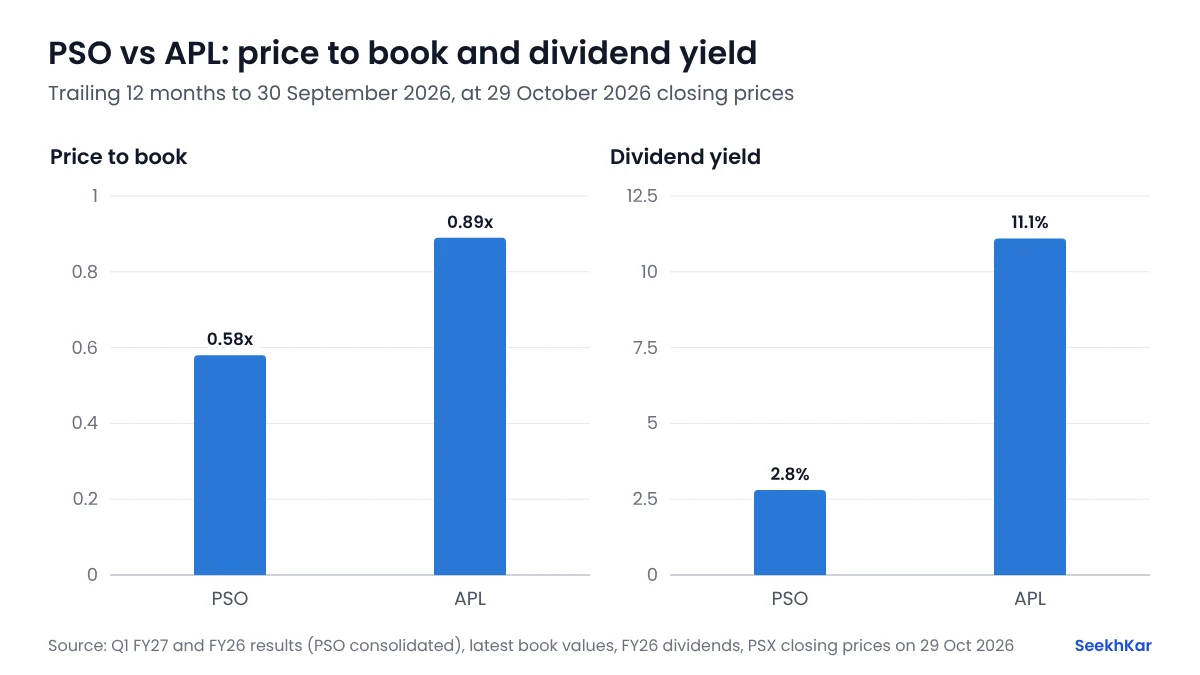
Both look very cheap, for different reasons. APL trades at 3.4 times trailing earnings and PSO at 3.8 times. On book value PSO is far cheaper: 0.58 times, against 0.89 for APL. Our guide to P/E ratios by sector puts these multiples in context.
The basis matters for PSO. On its own (standalone) accounts, without Pakistan Refinery, PSO earned Rs 66.54 a share over the last twelve months, so its standalone P/E is 5.4. Our guide to reading PSX annual reports explains the difference between standalone and consolidated figures.
A low P/E can also mean the market expects profits to fall. OMC earnings swing with fuel prices, because stock bought earlier at lower prices is sold at the new, higher price. PSO's group EPS went from Rs 8.91 in the December 2025 quarter to Rs 52.59 in the March 2026 quarter. Fuel prices were much higher in Q1 FY27 than a year earlier, and gains of this kind reverse when prices fall.
Q1 FY27 Results: Why Did Profits Jump?
| Quarter ended 30 Sep | Profit after tax, 2026 | 2025 | Change | EPS, 2026 | EPS, 2025 |
|---|---|---|---|---|---|
| PSO, standalone | Rs 25.56 bn | Rs 9.39 bn | +172% | Rs 54.44 | Rs 20.00 |
| PSO, group (shareholders' share) | Rs 29.42 bn | Not reported | Rs 62.66 | Rs 22.43 | |
| Attock Petroleum | Rs 6.64 bn | Rs 3.81 bn | +74% | Rs 53.36 | Rs 30.63 |
PSO took market share. According to PSO, its petroleum sales rose 17.8% against 7.1% for the industry, taking its market share to 45.9% from 41.7%. Petrol sales rose 23.2% to 968,000 tonnes and diesel 12.8% to 759,000 tonnes, and it supplies 99.6% of Pakistan's jet fuel. PSO says profit rose on higher volumes and a better product mix, partly offset by higher finance costs.
APL grew on margins. Net sales rose 36% and gross profit 56% to Rs 11.81 billion. APL also earned Rs 906 million of net finance income on its cash, while PSO pays interest on its borrowings. In September alone, APL sold 116,000 tonnes, unchanged from a year earlier, and its market share slipped to 8.6% from 9.6%.
Demand was weaker than it looks. Pakistan's fuel sales rose 6% to 4.11 million tonnes in the quarter, but mainly because furnace oil sales for power plants rose more than fivefold. Excluding furnace oil, sales were flat, and diesel fell 3%. The average petrol price was Rs 375 a litre in September, 42% higher than a year earlier, which holds back demand.
Circular Debt: PSO's Rs 909 Billion Problem
PSO's receivables were about Rs 908.7 billion on 20 July 2026, according to its daily position reported by Profit. That is more than five times PSO's market value. Rs 525 billion of it was overdue, including Rs 310 billion of late payment surcharge.
| Who owes PSO | Rs billion |
|---|---|
| SNGPL, for imported LNG | 535 |
| Power sector | 168 |
| FBR tax refunds and claims | 81 |
| Foreign exchange loss claims | 60 |
| PIA | 31 |
| Price differential claims | 24 |
This is circular debt: government-owned gas and power companies pay PSO late because they are paid late themselves. PSO borrows to fill the gap, so its net debt was about the same as its equity at 31 March 2026, and the interest eats into profit. It is the main reason PSO trades at about half its book value, while APL, whose receivables were only Rs 15.7 billion at 30 June 2026, has more cash than debt. The same problem affects the gas producers in our OGDC, PPL, Mari and POL comparison.
A settlement of this debt would help PSO more than any other OMC, since it is owed the most. Until then, much of PSO's profit is not collected in cash.
Which Pays the Higher Dividend?
| Company | FY26 dividend | Yield | Yield after 15% tax | Payout of TTM EPS |
|---|---|---|---|---|
| Attock Petroleum | Rs 60.00 (Rs 20 interim + Rs 40 final) | 11.1% | 9.4% | 38% |
| Pakistan State Oil | Rs 10.00 final | 2.8% | 2.4% | 11% |
APL pays far more. At 29 October prices, Rs 100,000 in APL would have earned about Rs 9,400 in dividends over the last year after the 15% withholding tax for filers, against about Rs 2,360 from PSO. APL can pay out more because it collects its cash: its net cash of about Rs 35 billion is roughly half its market value.
PSO pays out little because so much of its profit sits in receivables rather than in the bank. APL declared no dividend with its Q1 FY27 results. Our guide to dividend investing in Pakistan explains how to check whether a payout can last.
Scorecard: PSO or APL?
We ranked the two companies 1 (better) or 2 on six measures, with equal weight. A lower total is better.
| Company | P/E | P/B | Dividend yield | ROE | EPS growth | Debt | Total |
|---|---|---|---|---|---|---|---|
| Attock Petroleum | 1 | 2 | 1 | 1 | 2 | 1 | 8 |
| Pakistan State Oil | 2 | 1 | 2 | 2 | 1 | 2 | 10 |
- Income and balance sheet: Attock Petroleum. The higher yield, the higher ROE and net cash. The risks are a small, slipping market share and earnings that, like PSO's, depend on fuel prices.
- Value and scale: Pakistan State Oil. The country's largest fuel seller at about half its book value, with fast-growing market share. The risks are Rs 909 billion of receivables, borrowing to fund them, and a low payout.
Our oil marketing sector guide lists the other numbers to check, such as volumes, market share and receivables. This comparison is educational and is not a recommendation to buy or sell any stock. Prices change daily, and we update these figures after each quarterly result.
Sources & Further Reading
- Business Recorder: PSO Q1 FY27 profit jumps 172% to Rs25.6bn
- Investify: APL 3MFY27 profit jumps 74%
- Profit by Pakistan Today: PSO receivables hit Rs908.7bn as SNGPL dues exceed Rs535bn
- Business Recorder: OMC sales in September 2026 and Q1 FY27 (Topline Securities)
- Mettis Global: APL FY26 profit and Rs40 final dividend