Bank AL Habib vs NBP vs Alfalah vs Faysal: Bank Stocks 2026
On 30 October 2026 prices, Bank Alfalah (BAFL) scores best of these four banks: the lowest P/E at 4.9 times, the fastest growth with EPS up 43% in 9M 2026, and a 10.4% dividend yield. NBP is cheapest on book value and paid a record Rs 35 dividend, but its profit fell 26%.
Key takeaways
- Bank Alfalah scores 9 on our five-measure scorecard (lower is better), ahead of NBP on 12, Bank AL Habib on 14 and Faysal Bank on 15.
- Bank Alfalah's profit rose 43% to Rs 30.61 billion in 9M 2026, yet it trades at 4.9 times trailing earnings, the lowest P/E of the four.
- NBP's 21.9% trailing yield comes from one record Rs 35 final dividend for 2025. It has declared nothing since, its 9M 2026 profit fell 26%, and a September 2026 court ruling on pensions may add costs.
- Bank AL Habib pays Rs 3.50 every quarter (a 9.9% yield), but its 9M profit fell 9% as operating expenses rose 13%.
- Faysal Bank, a fully Islamic bank, has the highest ROE of the four at 19.2%, but it is the most expensive on P/E and P/B and its profit was flat.
PSX retail investor
M Zubair is a retail investor on the Pakistan Stock Exchange. He writes SeekhKar's guides to explain the basics of investing, such as reading annual reports, P/E ratios, dividends and valuation, in simple language for new PSX investors. Everything here is for learning, not investment advice.
BAHL vs NBP vs BAFL vs FABL: Valuation at a Glance
Bank AL Habib (BAHL), National Bank of Pakistan (NBP), Bank Alfalah (BAFL) and Faysal Bank (FABL) are the next tier of KSE-100 banks after the big four we compared in UBL vs Meezan vs HBL vs MCB. All four end their year on 31 December, so their results for the nine months to 30 September 2026 (9M 2026) cover the same period. Prices are PSX closing prices on 30 October 2026.
Earnings are trailing twelve months (TTM): 9M 2026 EPS plus the fourth quarter of 2025. Dividends are those declared during 9M 2026 plus the final dividend for 2025.
| Metric | BAHL | NBP | BAFL | FABL |
|---|---|---|---|---|
| Share price, 30 Oct 2026 | Rs 150.89 | Rs 159.72 | Rs 57.80 | Rs 91.40 |
| Market capitalisation | Rs 168 bn | Rs 340 bn | Rs 182 bn | Rs 139 bn |
| EPS, 9M 2026 | Rs 21.74 | Rs 22.83 | Rs 9.71 | Rs 10.33 |
| EPS, TTM | Rs 26.94 | Rs 31.92 | Rs 11.74 | Rs 14.88 |
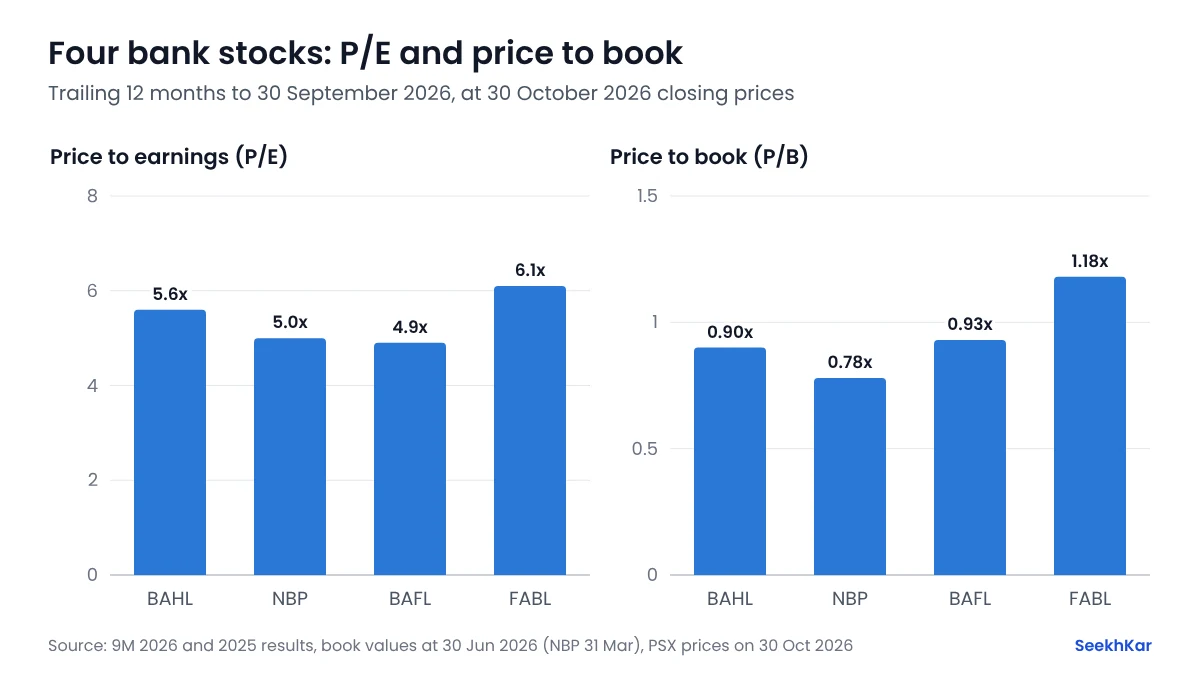
| P/E, TTM | 5.6x | 5.0x | 4.9x | 6.1x |
| Book value per share | Rs 166.95 | Rs 205.11* | Rs 62.37 | Rs 77.56 |
| P/B | 0.90x | 0.78x | 0.93x | 1.18x |
| ROE (TTM EPS ÷ book value) | 16.1% | 15.6% | 18.8% | 19.2% |
| Dividend per share, TTM | Rs 15.00 | Rs 35.00 | Rs 6.00 | Rs 6.50 |
| Dividend yield | 9.9% | 21.9% | 10.4% | 7.1% |
| EPS growth, 9M 2026 vs 9M 2025 | −9.4% | −26.1% | +42.8% | +0.8% |
All earnings are consolidated. Book values are from S&P Global data at 30 June 2026. *NBP's book value is at 31 March 2026, the latest S&P Global has for it. Bank Alfalah's 2025 per-share figures are as restated by the bank.
Which Bank Stock Is Cheapest?
Bank Alfalah on earnings, NBP on book value. Bank Alfalah trades at 4.9 times trailing earnings even though its profit grew fastest. NBP is close behind at 5.0 times, and it is the cheapest on book value at 0.78 times. Bank AL Habib and Bank Alfalah also trade below book, at about 0.9 times.
Faysal Bank is the only one priced above its book value, at 1.18 times, because it earns the highest return on that book: a 19.2% ROE. For a bank, P/B divided by ROE gives the P/E, so Faysal's higher P/B is partly paid for by its higher returns. Our guide to P/E ratios by sector explains why banks usually trade on lower multiples than other sectors.
9M 2026 Results: Who Grew and Who Shrank?
| Bank | Profit after tax, 9M 2026 | 9M 2025 | Change |
|---|---|---|---|
| NBP | Rs 49.12 bn | Rs 66.33 bn | −26% |
| Bank Alfalah | Rs 30.61 bn | Rs 21.44 bn | +43% |
| Bank AL Habib | Rs 24.18 bn | Rs 26.68 bn | −9% |
| Faysal Bank | Rs 15.68 bn | Rs 15.55 bn | +1% |
Bank Alfalah grew on fees and deposits. Its non-markup income rose 31% while expenses rose only 4.1%, and net interest income grew 5.5%. Deposits rose 20.8% to Rs 2.62 trillion. Its capital adequacy ratio was 14.79% at 30 September. (Bank Alfalah's 9M 2025 profit is worked out from its reported 42.8% growth.)
NBP's core income shrank. Net interest income fell 18% to Rs 156.12 billion, and gains on securities fell 23%. A Rs 6.03 billion net reversal of provisions softened the fall.
Bank AL Habib's costs rose faster than its income. Net interest income was flat at Rs 99.75 billion and operating expenses rose 13%. Its third quarter was better: profit rose 27% to Rs 8.77 billion.
Faysal Bank was flat. Non-funded income rose 20%, but expenses rose 7.6% and its reversal of credit losses was much smaller than a year earlier.
NBP: The 21.9% Yield and the Pension Ruling
NBP's trailing yield is not a regular income stream. In early 2026 it declared a record final dividend of Rs 35 a share for 2025, about Rs 74 billion in total, and it has declared no dividend with its 2026 results so far. That Rs 35 is 110% of its trailing EPS. NBP's total equity fell to Rs 438 billion at 31 March 2026 from Rs 538 billion at 31 December 2025, according to S&P Global data.
On 16 September 2026, the Federal Constitutional Court dismissed NBP's appeal in its long-running pension case, so its pensioners are entitled to the government's pension increases. The full judgment had not been released by then. Arif Habib Limited estimated that extra provisions could be Rs 5 billion to Rs 20 billion, and that each Rs 5 billion would cut annual EPS by about 3.4%.
NBP is cheap on book value, but a buyer is betting that profit recovers and that the pension cost stays at the low end of that range.
Which Pays the Higher Dividend?
| Bank | Declared, 9M 2026 | Final for 2025 | TTM dividend | Yield after 15% tax | Payout of TTM EPS |
|---|---|---|---|---|---|
| Bank Alfalah | Rs 4.50 | Rs 1.50 | Rs 6.00 | 8.8% | 51% |
| Bank AL Habib | Rs 10.50 | Rs 4.50 | Rs 15.00 | 8.5% | 56% |
| Faysal Bank | Rs 4.50 | Rs 2.00 | Rs 6.50 | 6.0% | 44% |
| NBP | None | Rs 35.00 | Rs 35.00 | 18.6% | 110% |
For steady income, Bank Alfalah and Bank AL Habib. Both declare a dividend every quarter: Rs 1.50 at Bank Alfalah and Rs 3.50 at Bank AL Habib in 2026. Each pays out about half its earnings, so the payout looks covered. At 30 October prices, Rs 100,000 in Bank Alfalah would have earned about Rs 8,800 over the last year after the 15% withholding tax for filers.
Faysal Bank also pays every quarter (Rs 1.50) but yields less. NBP's figure depends on one payment. Our guide to dividend investing in Pakistan explains how to check whether a payout can last.
Scorecard: Which Bank Stock Looks Best Value?
We ranked the four banks from 1 (best) to 4 on five measures, with equal weight, as in our big-four bank comparison. A lower total is better.
| Bank | P/E | P/B | Dividend yield | ROE | EPS growth | Total |
|---|---|---|---|---|---|---|
| Bank Alfalah | 1 | 3 | 2 | 2 | 1 | 9 |
| NBP | 2 | 1 | 1 | 4 | 4 | 12 |
| Bank AL Habib | 3 | 2 | 3 | 3 | 3 | 14 |
| Faysal Bank | 4 | 4 | 4 | 1 | 2 | 15 |
- Value with growth: Bank Alfalah. The lowest P/E, the fastest growth and a covered 10.4% yield. The risk is that some growth came from non-markup income, which can swing.
- Deep value: NBP. The lowest P/B. Its yield rank rests on one record dividend, and profit is falling while the pension cost is still unknown.
- Steady quarterly income: Bank AL Habib. Rs 3.50 every quarter and a P/E of 5.6. The risk is costs growing faster than income.
- Islamic banking: Faysal Bank. The highest ROE and the only Shariah-compliant stock of the four. We compare it with Meezan and Bank Makramah in our Islamic bank stock comparison.
Our banking sector guide explains the other numbers to check, such as deposits, capital adequacy and bad loans. This comparison is educational and is not a recommendation to buy or sell any stock. Prices change daily, and we update these figures after each quarterly result.