Meezan vs Faysal vs Bank Makramah: Islamic Bank Stocks 2026
On 30 October 2026 prices, Faysal Bank is the better value of the KSE-100's three Islamic banks: 6.1 times earnings and a 7.1% dividend yield. Meezan Bank earns the highest ROE (32.4%) but costs 10 times earnings and 3.2 times book. Bank Makramah lost Rs 5.78 billion in 9M 2026 and pays no dividend.
Key takeaways
- Faysal Bank scores 7 on our five-measure scorecard (lower is better), ahead of Meezan Bank on 9 and Bank Makramah on 14. Faysal is cheaper and yields more; Meezan earns far more on its equity and grew faster.
- Meezan Bank's ROE of 32.4% is the main reason it trades at 3.2 times book value, against 1.18 times for Faysal Bank.
- Faysal Bank pays Rs 1.50 a quarter: Rs 100,000 would have earned about Rs 6,040 over the last year after the 15% filer tax, against about Rs 4,900 from Meezan.
- Bank Makramah, the former Summit Bank, lost Rs 5.78 billion in 9M 2026 after a profitable 2025, yet trades at 2.6 times its book value.
- All three are fully Islamic banks, so their shares suit investors who want a Shariah-compliant bank stock.
PSX retail investor
M Zubair is a retail investor on the Pakistan Stock Exchange. He writes SeekhKar's guides to explain the basics of investing, such as reading annual reports, P/E ratios, dividends and valuation, in simple language for new PSX investors. Everything here is for learning, not investment advice.
Meezan vs Faysal vs Bank Makramah: Valuation at a Glance
Meezan Bank (MEBL), Faysal Bank (FABL) and Bank Makramah (BML) are the three fully Islamic banks in the KSE-100 index. Meezan Bank operates only as an Islamic bank. Faysal Bank converted all its branches and received an Islamic banking licence at the end of 2022, and Summit Bank became Bank Makramah when it converted in November 2023. All three end their year on 31 December. Prices are PSX closing prices on 30 October 2026.
Earnings are trailing twelve months (TTM): 9M 2026 EPS plus the fourth quarter of 2025. Dividends are those declared during 9M 2026 plus the final dividend for 2025.
| Metric | MEBL | FABL | BML |
|---|---|---|---|
| Share price, 30 Oct 2026 | Rs 528.61 | Rs 91.40 | Rs 58.33 |
| Market capitalisation | Rs 955 bn | Rs 139 bn | Rs 60 bn |
| EPS, TTM | Rs 52.90 | Rs 14.88 | Loss of Rs 3.04 |
| P/E, TTM | 10.0x | 6.1x | Loss |
| Book value per share, 30 Jun 2026 | Rs 163.44 | Rs 77.56 | Rs 22.22 |
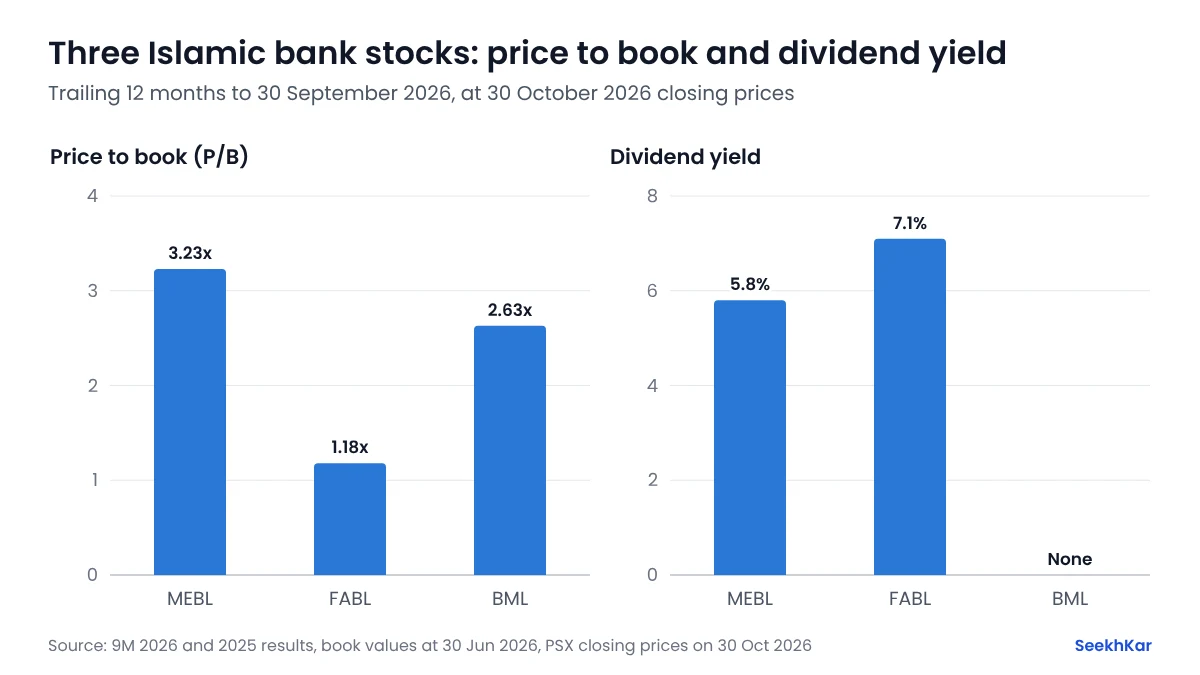
| P/B | 3.23x | 1.18x | 2.63x |
| ROE (TTM EPS ÷ book value) | 32.4% | 19.2% | Negative |
| Dividend per share, TTM | Rs 30.50 | Rs 6.50 | None |
| Dividend yield | 5.8% | 7.1% | 0% |
| EPS growth, 9M 2026 vs 9M 2025 | +6.3% | +0.8% | Profit to loss |
Earnings are consolidated where the bank reports a group. Book values are from S&P Global data at 30 June 2026. Meezan's earnings and dividends are the same as in our big-four bank comparison, at the 30 October price.
Is Meezan Bank Worth Its Premium?
Meezan costs more because it earns more. It earned a 32.4% return on its book value over the last twelve months, against 19.2% at Faysal Bank. For a bank, P/B divided by ROE gives the P/E: Meezan's 3.23 times book at a 32.4% ROE works out to 10.0 times earnings, and Faysal's 1.18 times book at 19.2% to 6.1 times.
So on earnings, Faysal is about 40% cheaper. Meezan's premium buys a larger, faster-growing bank: its 9M 2026 profit rose 5.9% to Rs 74.65 billion, nearly five times Faysal's Rs 15.68 billion, and its third-quarter profit rose 11%. Faysal's profit was flat.
9M 2026 Results
| Bank | Profit after tax, 9M 2026 | 9M 2025 | EPS, 9M 2026 | EPS, 9M 2025 |
|---|---|---|---|---|
| Meezan Bank | Rs 74.65 bn | Rs 70.52 bn | Rs 41.02 | Rs 38.59 |
| Faysal Bank | Rs 15.68 bn | Rs 15.55 bn | Rs 10.33 | Rs 10.25 |
| Bank Makramah | Loss of Rs 5.78 bn | Rs 0.88 bn | Loss of Rs 5.68 | Rs 0.88 |
Faysal Bank: non-funded income rose 20%, but expenses rose 7.6% and its reversal of credit losses fell to Rs 1.34 billion from Rs 4.20 billion, so profit was flat.
Bank Makramah: the profit it earned on financing fell faster than what it paid depositors, so it paid out Rs 2.70 billion more than it earned on that line, against Rs 0.83 billion a year earlier. Gains on securities fell to Rs 84 million from Rs 2.00 billion, and a smaller release of credit losses added to the loss.
Bank Makramah: A Turnaround Still in Progress
Bank Makramah has been rebuilt from negative equity. S&P Global data show shareholders' equity of minus Rs 13.1 billion at 30 September 2025 and plus Rs 23.7 billion at 31 December 2025, after a restructuring that brought in new capital and raised its share count to about 1 billion from 331 million. It reported a profit of Rs 7.94 billion in the December 2025 quarter.
In 2026 it has lost money in every quarter, and its book value per share fell to Rs 22.22 at 30 June from Rs 25.59 at 31 March. At Rs 58.33, the market values it at 2.6 times that book value, which prices in a recovery that has not shown up in its results yet. It is much smaller than the other two: deposits of Rs 191 billion at 30 June 2026, against Rs 1.56 trillion at Faysal Bank.
Which Islamic Bank Pays the Higher Dividend?
| Bank | Declared, 9M 2026 | Final for 2025 | TTM dividend | Yield | Yield after 15% tax | Payout of TTM EPS |
|---|---|---|---|---|---|---|
| Faysal Bank | Rs 4.50 | Rs 2.00 | Rs 6.50 | 7.1% | 6.0% | 44% |
| Meezan Bank | Rs 23.50 | Rs 7.00 | Rs 30.50 | 5.8% | 4.9% | 58% |
| Bank Makramah | None | None | None | 0% | 0% |
Faysal Bank yields more and pays out less of its earnings, so its dividend has more room. Meezan pays far more per share, Rs 30.50 against Rs 6.50, but its higher share price means a lower yield. The dividend calculator works out your income after tax from any of these payouts.
Scorecard: Which Islamic Bank Stock?
We ranked the three banks 1 (best) to 3 on the same five measures as our other bank comparisons. A lower total is better. Bank Makramah's loss puts it last on P/E, ROE and growth.
| Bank | P/E | P/B | Dividend yield | ROE | EPS growth | Total |
|---|---|---|---|---|---|---|
| Faysal Bank | 1 | 1 | 1 | 2 | 2 | 7 |
| Meezan Bank | 2 | 3 | 2 | 1 | 1 | 9 |
| Bank Makramah | 3 | 2 | 3 | 3 | 3 | 14 |
- Value and income: Faysal Bank. The lowest P/E and P/B and the highest yield. The risk is flat profit.
- Quality and growth: Meezan Bank. The highest ROE and the fastest growth among the three. The risk is paying 10 times earnings and 3.2 times book.
- Turnaround bet: Bank Makramah. A small bank still losing money after its recapitalisation, priced well above its book value.
For how Shariah screening works for shares, read our KMI-30 Shariah investing guide. Faysal Bank is also compared with conventional banks in our Bank AL Habib, NBP, Bank Alfalah and Faysal comparison. This comparison is educational and is not a recommendation to buy or sell any stock. Prices change daily, and we update these figures after each quarterly result.
Sources & Further Reading
- Mettis Global: Meezan Bank 9MCY26 results and Rs8 dividend
- Mettis Global: Faysal Bank 9M CY26 profit and Rs1.5 dividend
- Mettis Global: Bank Makramah swings to Rs6bn loss in 9MCY26
- Profit by Pakistan Today: Faysal Bank branches now 100% Islamic
- Wikipedia: Bank Makramah (Summit Bank converted to an Islamic bank in November 2023)