Policy Rate in Pakistan 2026: History and Impact on Stocks
The SBP policy rate in Pakistan is 12%, after a 0.5-point rise on 26 October 2026. It peaked at 22% and fell to 10.5% by December 2025 before two hikes. Rate cuts usually lift the KSE-100, especially cement, autos and power, while hikes help bank profits but pressure borrowers and share prices.
Key takeaways
- The State Bank raised the policy rate by 0.5 point to 12% on 26 October 2026, effective 27 October, citing the Middle East conflict, energy prices and wheat supply disruptions.
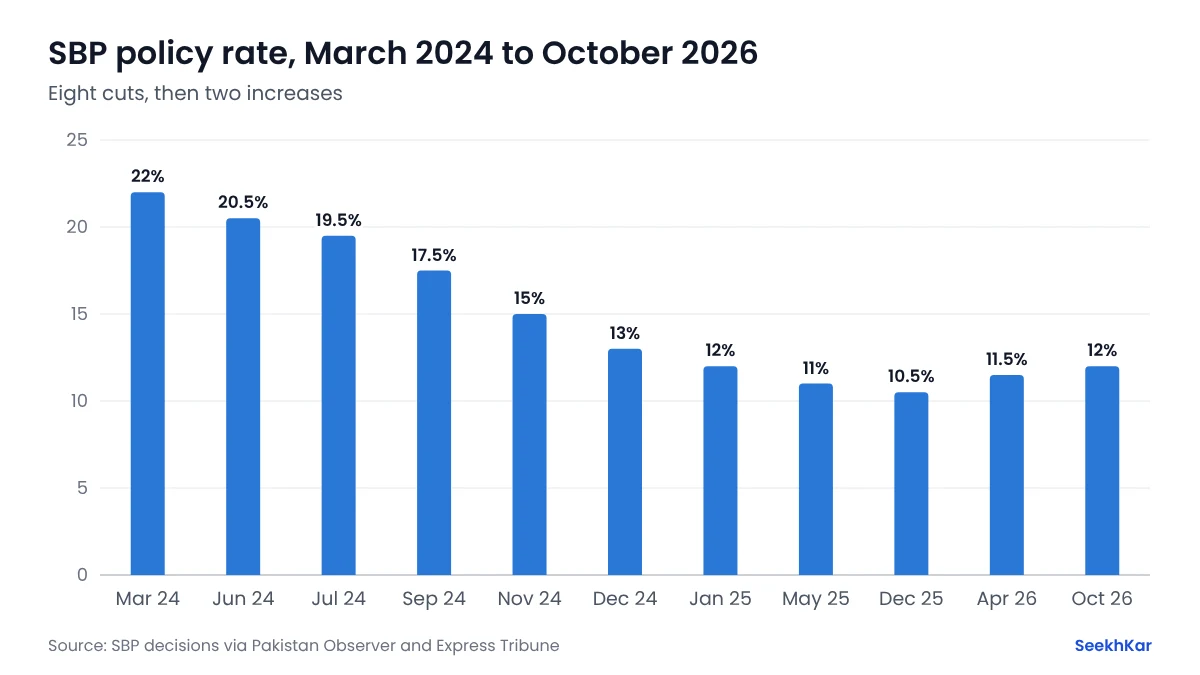
- Since March 2024 the SBP has made eight cuts, from a record 22% to 10.5% in December 2025, and two increases, to 11.5% in April 2026 and 12% in October 2026.
- Falling rates were a big reason the KSE-100 rallied from 2024: deposits paid less, so money moved into shares.
- A hike tends to help bank profits and cash-rich companies, and hurt companies with heavy borrowing such as cement, steel and autos.
- The market often moves before the decision: the KSE-100 fell 1,174 points on the day of the April 2026 hike.
PSX retail investor
M Zubair is a retail investor on the Pakistan Stock Exchange. He writes SeekhKar's guides to explain the basics of investing, such as reading annual reports, P/E ratios, dividends and valuation, in simple language for new PSX investors. Everything here is for learning, not investment advice.
What Is the Policy Rate in Pakistan Today?
The policy rate is the interest rate the State Bank of Pakistan (SBP) sets to control inflation. Banks price their loans and deposits around it, so it decides how much you earn on savings, how much a car or home loan costs, and how much companies pay on their borrowing.
On 26 October 2026 the SBP's Monetary Policy Committee raised the policy rate by 50 basis points (0.5 percentage point) to 12%, effective 27 October 2026. Nine of the ten members voted for the increase. The SBP said the Middle East conflict, higher energy prices and disruptions to domestic wheat supply had worsened the inflation outlook.
Policy Rate History: From 22% to 12%
The rate has moved a long way in a short time. When the current government took office on 4 March 2024, it was at a record 22%. Here is every change since:
| Decision | Policy rate | Change |
|---|---|---|
| March 2024 | 22.0% | — |
| 10 June 2024 | 20.5% | −1.5 |
| 29 July 2024 | 19.5% | −1.0 |
| September 2024 | 17.5% | −2.0 |
| November 2024 | 15.0% | −2.5 |
| December 2024 | 13.0% | −2.0 |
| January 2025 | 12.0% | −1.0 |
| May 2025 | 11.0% | −1.0 |
| 15 December 2025 | 10.5% | −0.5 |
| April 2026 | 11.5% | +1.0 |
| 26 October 2026 | 12.0% | +0.5 |
That is eight cuts and two increases. The latest hike brings the rate back to the 12% level first reached in January 2025, and leaves it 10 points below the 2024 peak.
How the Policy Rate Moves the Stock Market
Interest rates affect share prices in three ways:
- Competition for your money. When a bank deposit pays 20%, few people take the risk of shares. When it pays 10%, shares paying 8–10% in dividends plus growth look much better, so money flows into the market. That shift drove much of the KSE-100's rally from 2024; we show how much in our comparison of gold, shares, bank savings and dollars.
- Company profits. Companies with large loans pay less interest when rates fall, so their profits rise. Banks are the exception: they earn more when rates are high.
- Valuations. Investors value a company by its future profits, discounted at a rate linked to interest rates. Lower rates make the same profits worth more today, so P/E ratios rise.
The market usually moves before the decision, on expectations. On 27 April 2026, the day of the SBP's 1-point hike to 11.5%, the KSE-100 fell 1,174 points to 169,497, with selling across autos, cement, banks, fertiliser and oil and gas. The October 2026 hike was widely expected, and analysts said the broader outlook remained intact, advising investors to focus on strong, cash-generating sectors.
Which Sectors Gain and Lose When Rates Change
| Sector | When rates rise | When rates fall |
|---|---|---|
| Banks | Usually gain: wider margins on loans and investments | Profits come under pressure |
| Cement, steel | Lose: heavy borrowing costs more, construction slows | Gain: lower finance costs, more building |
| Autos | Lose: car loans cost more, sales slow | Gain: car financing gets cheaper |
| Power (IPPs) | Mixed: finance costs rise | Gain: lower finance costs |
| Cash-rich companies (E&P, some FMCG) | Gain: earn more on cash | Earn less on cash |
Brokers' analysis after rate cuts in 2024 named cement, power, textile, chemical and auto stocks as winners, and banks, oil and gas exploration and fertiliser as the sectors that would find it harder. After the October 2026 hike, analysts pointed the other way: banks and energy companies may benefit from higher rates through better margins and higher returns on cash. You can compare the banks in our UBL, Meezan, HBL and MCB comparison and the cement makers in our Lucky, Fauji, Maple Leaf and DG Khan comparison.
What the Policy Rate Means for You
- If you save: higher rates mean better profit on savings accounts and term deposits. Check what your balance earns with our FD calculator.
- If you borrow: variable-rate loans, such as most car and home financing, get more expensive after a hike.
- If you invest in shares: a single hike rarely changes a long-term plan. Watch the direction: a run of cuts has historically been good for the KSE-100, and a run of hikes bad for leveraged sectors.
Rates also decide which companies can carry their debt. Our PSX stock analysis checklist shows how to check interest cover and borrowing before you buy.
This article explains how interest rates work and is not a recommendation to buy or sell any stock.
Sources & Further Reading
- Express Tribune: SBP raises policy rate by 50bps to 12% (26 October 2026)
- Pakistan Observer: Eight cuts, two hikes, policy rate timeline from March 2024 to October 2026
- Express Tribune: PSX drops 1,174 points on rate hike anxiety (April 2026)
- ProPakistani: these 5 key sectors will benefit from the SBP rate cut (Arif Habib Limited, June 2024)
- Arab News: Pakistan's rate hike signals shift to tighter policy, analysts on sectors